
A Pre-Approval Inspection is the most consequential FDA visit any drug program will ever receive. It is the only inspection that gates approval. It happens after years of clinical work, after the BLA or NDA is on file, after the marketing plan is set and the launch quarter is locked in. The investigator who walks the floor that week is the last gate between a finished application and a market launch.
For a contract manufacturer, that visit is not a quality event. It is the single largest commercial event the facility participates in on any given product.
Sponsors are increasingly hiring CMOs on the basis of what happens during that week. That changes who carries the risk — and where the inspection-readiness work actually has to live.
CMOs are the last line
The CMO is the physical last point of control between manufactured drug and patient. That description is operational, not metaphorical. The CMO operates the equipment. The CMO holds the batch records. The CMO’s procedures determine what gets released and what gets rejected. The CMO’s inspection methodology decides which units leave the facility.
That role used to be transactional. It is not transactional anymore.
Three structural changes have moved CMOs from a manufacturing-services posture to a regulatory front line. First, sponsors have outsourced an increasing share of biologics production over the past decade, particularly in lyophilized formats, sterile injectables, suspensions, and the cell-and-gene therapy categories where in-house capacity is genuinely scarce. Second, the FDA has tightened expectations on contamination control, visual inspection, and process validation — most visibly through the 2022 revision to EU-GMP Annex 1, which the FDA’s own field force has effectively harmonized to during inspections. Third, the regulatory event rate has moved against manufacturing. Roughly 55% of FDA Complete Response Letters in recent years have been tied to manufacturing deficiencies rather than clinical failures. Inspection-related observations are now a recurring 483 theme on Pre-Approval Inspections.
The combined effect is that a CMO’s PAI history has become a sales document. A clean PAI record wins biologics work. A recurring 483 pattern — particularly anything tied to visual inspection methodology — quietly explains a CMO out of RFPs that the sales team never sees.
This is the framing the rest of this piece works from. PAI readiness is not an isolated QA project anymore. It is a structural property of the business.
What a Pre-Approval
Inspection actually is
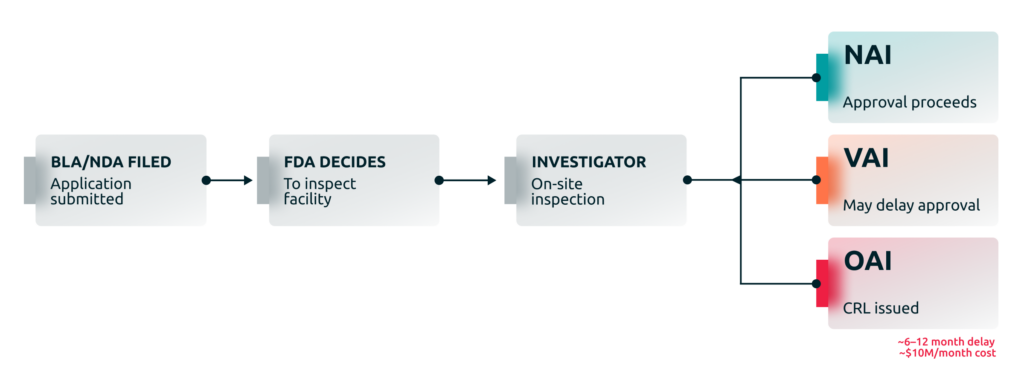
A PAI is triggered by a marketing application — a New Drug Application, a Biologics License Application, or in some cases a supplement that adds a new dosage form, facility, or manufacturing process. Once the application is filed, the FDA decides whether to inspect the manufacturing facilities listed on the submission. For new products, complex biologics, and any facility with a prior inspection history of concern, the answer is essentially always yes.
The investigator’s job during a PAI is narrower and deeper than during a routine cGMP inspection. The scope is the specific product on the application, the specific facility, the specific equipment trains, and the specific data that supports the submission. The questions are concrete. Does the process described in the application match what is actually running on the floor? Are the validation studies real, reproducible, and documented? Do the deviation records add up? Can you produce the data the application cited, on demand, with full traceability?
PAIs end in one of three dispositions. NAI — No Action Indicated — means the inspection produced no actionable observations and approval can proceed on its normal timeline. VAI — Voluntary Action Indicated — means the FDA observed deficiencies that the sponsor and facility are expected to remediate voluntarily; approval typically still proceeds, though the FDA may delay action until remediation is documented. OAI — Official Action Indicated — means the deficiencies are serious enough that the agency will not approve the application as filed. OAI is typically the predicate for a Complete Response Letter, which stops the review clock and pushes approval out by an average of six to twelve months, longer when new studies are required. Industry analyses commonly cite delay costs of approximately $10 million per month for a major launch.
The structural point is that a PAI is the moment when years of work either translate into approval or do not. The cost of failure is not absorbed by the quality cost center. It is absorbed by the business.
What investigators actually examine
The PAI agenda is published; the examination is not. Investigators rotate, sites differ, and judgment varies. But the categories that produce most observations are consistent across recent inspection cycles.
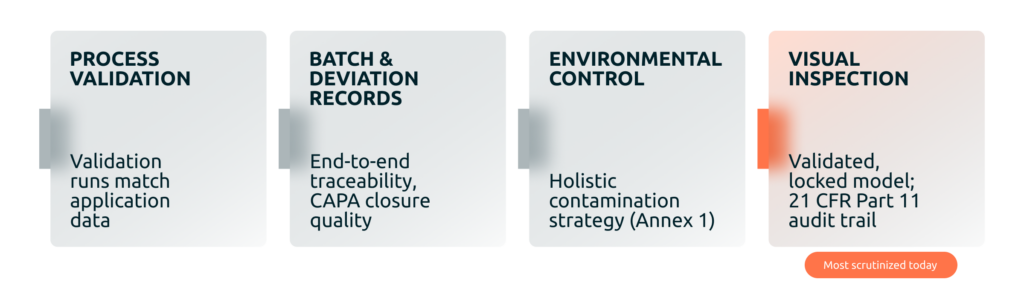
Process validation is the first category. The FDA wants evidence that the manufacturing process described in the application performs reliably across the validation runs, that the validation strategy follows current FDA Process Validation guidance, and that the process performance qualification was executed with the rigor the submission claims. Gaps between application narrative and actual production data are typically the largest single source of significant findings.
Batch and deviation records are the second category. Investigators trace specific batches end-to-end — raw material release, in-process testing, environmental data, deviations, CAPA closures, and final disposition. The trace has to be complete and consistent. Deviations that closed without root-cause clarity, CAPAs that did not measurably change behavior, and batch records with unexplained anomalies generate observations quickly.
Environmental and contamination control is the third category, and the one that has changed the most. The 2022 revision to EU-GMP Annex 1 introduced an explicit contamination control strategy expectation that has become a focal point of FDA inspections as well. Facilities running sterile fill-finish operations are expected to demonstrate a holistic strategy — not a collection of procedures — that prevents and detects contamination across the full operating envelope.
Visual inspection methodology is the fourth category, and it is where the structural change has been most pronounced. The investigators are looking for specific properties of the inspection program. Is the detection methodology validated, documented, and locked at the point of qualification? Are challenge sets representative of actual defect types the line encounters, not synthetic substitutes? Is the IQ/OQ/PQ documentation aligned to FDA Process Validation guidance, USP <1790> for visual inspection of injectable products, and the contamination-control framework in Annex 1? Is there a 21 CFR Part 11 audit trail for inspection events, recipe changes, and threshold modifications? Can the facility detect novel defect types that were not in the original training or rule set?
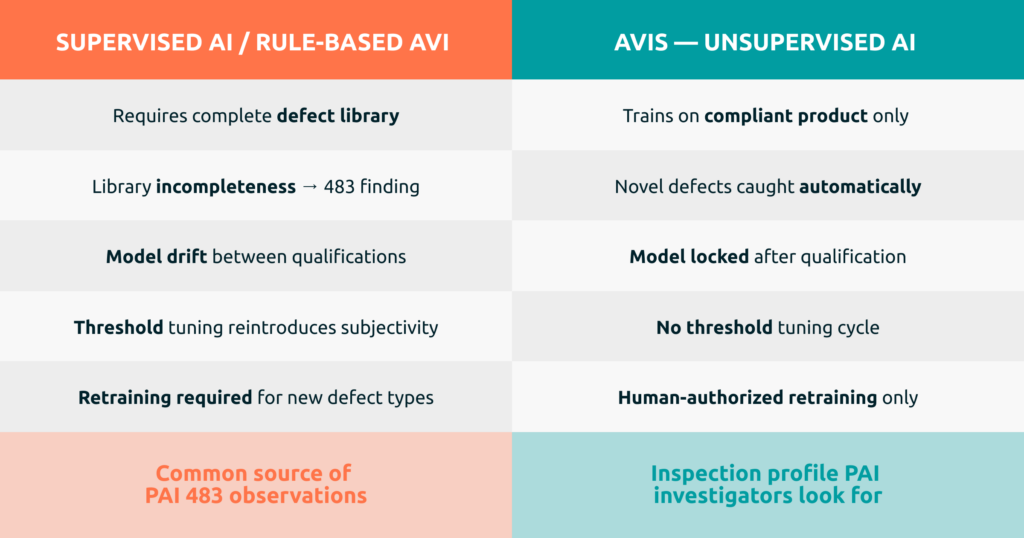
The last of those questions is the one that creates the most exposure today. Supervised-AI inspection systems and rule-based AVI systems are routinely cited on PAI 483s for inadequate challenge sets, undocumented model adaptation, and threshold-tuning that reintroduces inspector subjectivity into a process that was supposed to remove it. The library-completeness and model-drift themes have moved from niche concerns to recurring observation categories.
A clean PAI on visual inspection methodology now requires a structural inspection profile, not just better documentation.
Why this falls to the CMO
A sponsor’s BLA or NDA names the CMO and the specific facility. The investigator inspects the facility. The 483 lands on the facility. The remediation runs through the facility’s quality system.
That sequence used to feel administrative. It has become structural.
Three forces converge on the CMO during a PAI in ways they did not converge five years ago. First, sponsor portfolios have shifted toward biologics, lyophilized injectables, and complex molded-glass formats — exactly the products where traditional inspection methodologies underperform and where the FDA is paying the most attention. A CMO whose inspection program was validated against simple sterile vials in 2018 is being inspected against 2026 standards on a 2026 product portfolio.
Second, the FDA has signaled — through warning letter trends, Annex 1 harmonization, and direct guidance — that contamination control and visual inspection are joint program-level responsibilities, not isolated production tasks. The agency expects the CMO’s inspection methodology to demonstrably reduce risk across the contamination control strategy, not just catch defects at end-of-line.
Third, sponsors have started writing inspection methodology into their CMO selection criteria. Vendor evaluation processes that used to ask about cost-per-vial and changeover time now ask about false-reject rates, recipe-creation timelines, novel-defect detection, audit-trail compliance, and Annex 1 alignment. The CMO that answers those questions well gets the contract. The CMO that doesn’t, doesn’t.
This is the practical content of “CMOs are the last line.” The CMO carries the regulatory event, the FDA-facing remediation, and the commercial consequence — increasingly without sponsor cushioning.
What the right inspection
profile actually looks like
The inspection methodology that satisfies a modern PAI has a consistent shape. The model is trained, validated, and locked at the point of qualification, so the FDA can audit a specific, fixed detection behavior rather than a continuously drifting one. Training does not depend on a labeled defect library, because library completeness is structurally unprovable and is one of the most common 483 themes for supervised-AI systems. Detection is anchored on the compliant product, so novel defect types are flagged automatically without retraining or library expansion. Documentation is complete: IQ/OQ/PQ aligned to FDA Process Validation guidance, USP <1790>, and Annex 1; full 21 CFR Part 11 audit trail; defined challenge-set strategy that uses real defect types from the line in question.
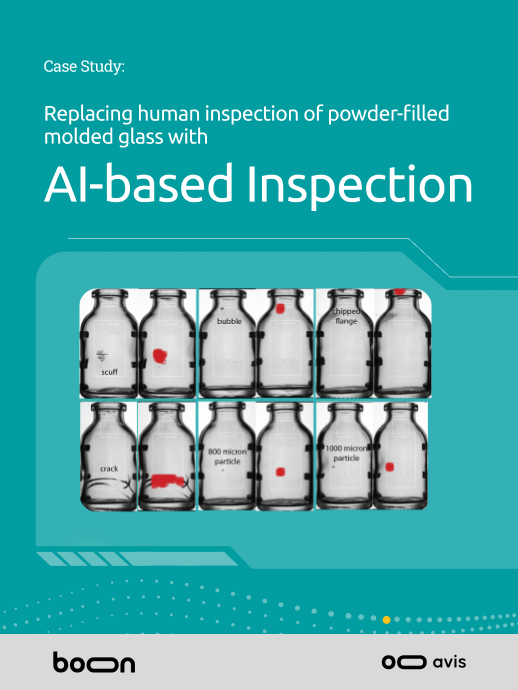
That profile maps to unsupervised-AI visual inspection. AVIS by Boon Logic was designed against it. The system trains exclusively on compliant product, requires no labeled defect library, and is locked after qualification — producing documented false reject rates of 1 to 6% on complex products including lyophilized vials, powder-filled containers, and suspensions in molded glass, with case-study performance of 2.7% on 20-mL powder-filled molded glass vials at 98% defect detection accuracy. Recipe creation runs under sixty minutes per SKU on roughly 500 pre-inspected compliant units. The model behavior does not drift between qualification events, so the threshold-tuning cycle that produces most inspection-driven deviations — and most PAI inspection-methodology observations — is removed from the operation entirely.
Two architectural properties matter most in PAI terms. The first is that detection is defined against the compliant baseline rather than an enumerated defect library, which means novel defect types are caught the first time they occur, without library updates, retraining, or requalification. That removes the most common library-completeness 483 finding. The second is that the model is locked after training, with adaptation requiring a deliberate, human-authorized retraining event and its own qualification baseline. That removes the model-drift 483 finding.
The combination is the inspection profile investigators are explicitly looking for during a Pre-Approval Inspection on complex sterile product.
The decision
PAI readiness is not a quality department line item anymore. It is the entry cost of being the CMO that wins the next biologics contract.
Two pressures are compounding. Regulatory expectations are rising — Annex 1, contamination control strategies, the FDA’s increasing focus on visual inspection methodology — and they are rising fastest on the categories that have the most growth. Product complexity is rising at the same rate, driven by the shift toward biologics, cell and gene therapies, lyophilized formats, and suspensions. The inspection technology in the facility has to move at the same rate as both. Inspection programs that were adequate in 2018 will produce 483s in 2026.
The CMOs that recognize this are the ones positioning themselves as the inspection-first manufacturer for the biologics decade. The CMOs that don’t are explaining themselves out of RFPs they used to win.
A PAI is the moment that distinction becomes visible. The structural work has to happen well before the investigator arrives.
Read the full disruption thesis. Our white paper on automated visual inspection in pharmaceutical manufacturing walks through the four-modality framework (manual, SAVI, AVI, AVIS), the regulatory pressure shaping current inspections, the engineering profile that satisfies a modern PAI, and the case-study performance of unsupervised AI on lyophilized, powder-filled, and suspension products.