
Lyophilized injectables are the fastest-growing segment of the injectable drug market. They are also the hardest products in the modern pharmaceutical portfolio to inspect. The two facts are related, and they create a structural problem that most facilities have been working around rather than solving.
Traditional automated visual inspection was designed for products that hold still. Clear liquid in a clear vial. Repeatable fill levels. A defined defect catalog. Visual signatures that look the same on Tuesday as they did on Monday. That world produced inspection technology that depends on tight templates, narrow thresholds, and labeled defect libraries — and that technology works well on the products it was built for.
Lyophilized product does not hold still. The freeze-drying process introduces visual variation that is real, legitimate, and unavoidable. Every cake is slightly different. Every meniscus is slightly different. Every shadow on every stopper is slightly different. None of those differences are defects. All of them look like defects to a system built around templates and thresholds.
This is the rule that lyophilized inspection breaks. The compliant product is heterogeneous by design. The defect set is open-ended. The inspection technology that assumed otherwise is structurally inadequate for the products driving the next decade of growth in the injectable market.
Why lyophilized product is structurally hard to inspect
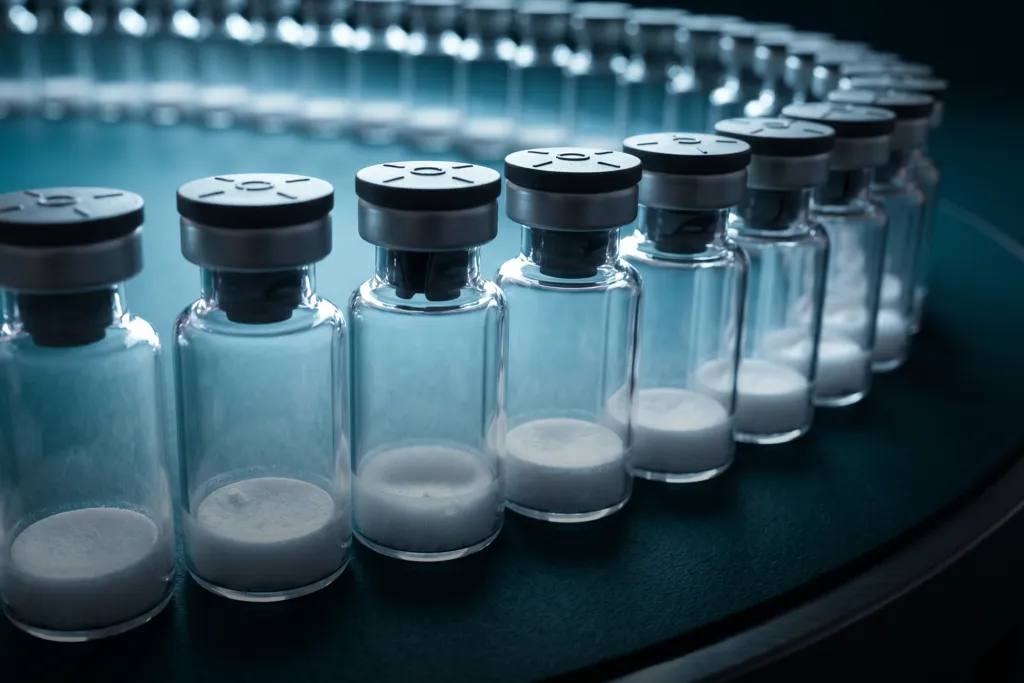
Lyophilization — freeze-drying — converts a liquid drug into a stable solid cake inside a sealed vial. The process matters because it preserves biologics and other heat-sensitive molecules that would otherwise degrade in solution. The visual consequence matters because the cake that comes out of the lyophilizer is not a uniform tablet. It is a porous, irregular structure shaped by ice crystal growth, primary drying, and secondary drying — each of which legitimately varies within the validated process envelope.
The result is a population of compliant products with broad, legitimate visual variation. Cake density varies. Cake color varies — especially for biologics, where slight Maillard browning or protein excipient interactions are normal within specification. Cake shape varies — concave, convex, slightly tilted, slightly cracked at the meniscus, sometimes adhered to the vial wall, sometimes shrunken away from it. Surface texture varies — smooth, fibrous, fragmented. Headspace position varies because cake height is not perfectly uniform. Stopper position varies because the cake interacts with stopper seating.
Real defects exist in the same visual envelope. Collapse, melt-back, fibers, glass particles, stopper deformation, foreign matter embedded in the cake, cracking at clinically significant locations. Some of these are catastrophic. Some are cosmetic. Most of the cosmetic ones look superficially identical to legitimate process variation. Some of the catastrophic ones — fine fibers, micro-particulates trapped in cake voids — look superficially identical to the speckled texture that a normal cake naturally produces.
Compliant product and defective product live inside the same visual space. The inspection system has to separate them with confidence. The mechanism by which a system separates them is what determines whether it can handle lyophilized product at all.
Why rule-based AVI fails on lyo
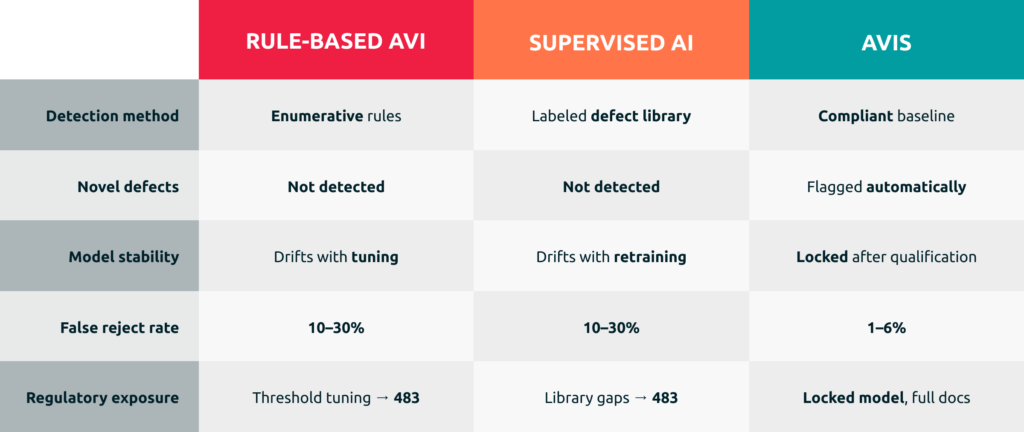
Rule-based automated visual inspection separates compliant product from defective product by defining what a defect looks like and configuring thresholds that fire when the defect signature appears. The mechanism is fundamentally enumerative. Engineers write rules — pixel-area thresholds, shape-similarity scores, color-deviation bounds — that describe what the system should flag. The rules sit on top of a defect catalog maintained per SKU.
That approach works on a clear-liquid vial in molded glass. The compliant product has a narrow visual envelope. A few well-chosen rules cover most real defects with acceptable false-reject performance.
It fails on lyophilized product for three structural reasons.
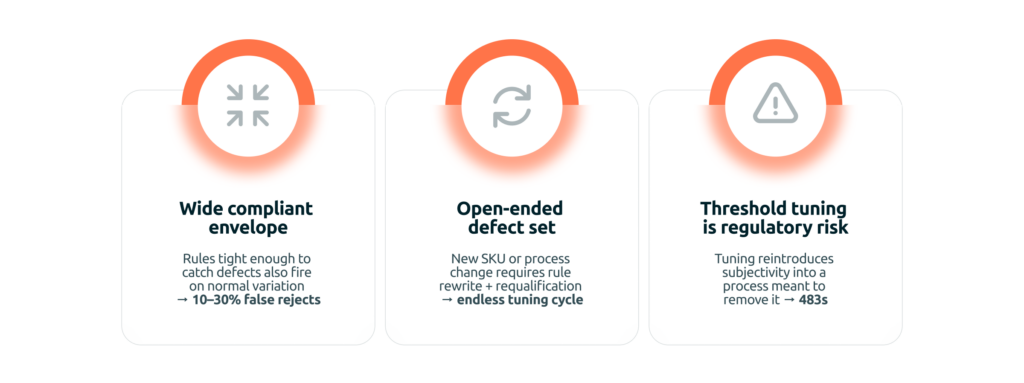
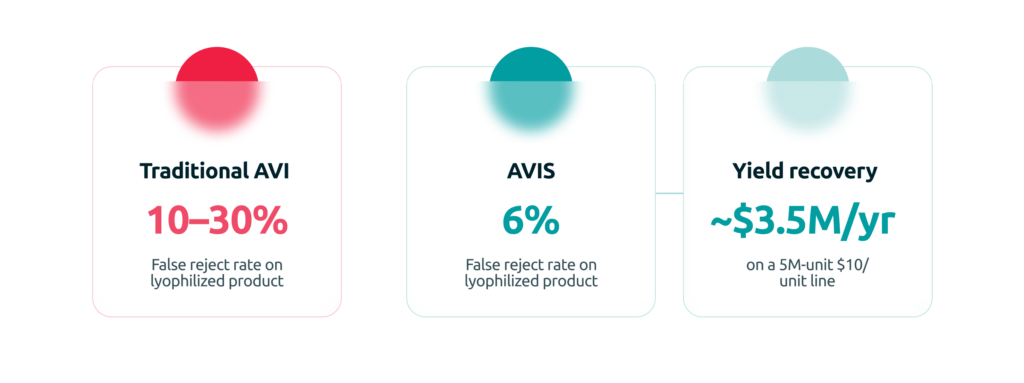
The first reason is that the compliant envelope is wide. A rule tight enough to catch a real defect inside the cake — say, a fine particle embedded in a pore — will also fire on the normal texture variation that the next vial happens to present. Industry-published false reject rates for traditional AVI on complex products run 10 to 30%. On lyophilized lines specifically, the upper end of that range is more common than the lower end. Each false reject is a compliant unit ejected as finished-goods waste.
The second reason is that the defect set is open-ended. A new biologic formulation produces new cake morphologies. A change in stoppering equipment produces new cosmetic patterns. A change in lyophilizer load configuration changes shadow patterns across the cake surface. Each change requires re-writing rules, re-validating thresholds, and re-qualifying the system. The threshold-tuning cycle becomes the dominant operating cost of the inspection program, and the same cycle is also the leading source of inspection-driven deviations.
The third reason is regulatory. Threshold tuning is a recurring 483 theme during Pre-Approval Inspections because it reintroduces inspector subjectivity — by way of the engineer adjusting the threshold — into a process that was supposed to remove it. The more lyophilized SKUs a facility runs, the more threshold tuning is happening, and the larger the regulatory surface area gets.
Why supervised AI also fails on lyo
Supervised AI visual inspection replaces hand-tuned rules with a model trained on labeled defect images. The system learns to recognize specific defect types from thousands of annotated examples and applies that learned pattern to new units coming off the line. On paper, supervised AI looks like the answer to rule-based AVI’s brittleness.
On lyophilized product, it inherits a different version of the same problem.
Supervised models can only detect defect types that exist in the training library. That requirement is the entire premise. The library has to be curated, labeled, and validated — typically tens of thousands of annotated images per defect type per product. For lyophilized products, the requirement is structurally unachievable. Defect types are too varied, too rare in absolute terms, and too dependent on specific process conditions to enumerate completely. A library that captures every defect a 20-mL biologic might present on Monday will miss the new failure mode that appears on Wednesday after a stoppering change.
Three operational consequences follow. First, novel defect types — the failure modes the library has not seen — are not detected. That blind spot is the most common observation theme on Pre-Approval Inspections of supervised-AI systems. Second, library curation becomes a perpetual engineering project. Every new SKU, every formulation change, every stoppering modification triggers an expansion of the labeled dataset, retraining, and requalification.
The all-in cost of maintaining a supervised library at scale runs into seven figures annually on a multi-SKU lyophilized line. Third, the regulatory exposure is structural — the FDA can ask, and routinely does ask, what defect types the library covers and whether the challenge set is representative. The library is always finite. The defect space is not.
Supervised AI moves the failure mode from threshold-tuning subjectivity to library-completeness subjectivity. The inspection program still depends on enumeration. Lyophilized product still resists enumeration.
What actually works: training on the compliant baseline
The architectural shift that handles lyophilized product correctly is to stop enumerating defects and start modeling the compliant baseline.
Unsupervised AI visual inspection — the category AVIS by Boon Logic operates in — trains exclusively on pre-inspected compliant product. The model learns the full envelope of legitimate visual variation: the range of cake morphologies, the distribution of meniscus shapes, the spread of color values, the patterns of normal headspace and stopper positioning, the texture variability across the validated lyophilization profile. Anything outside that statistical envelope is flagged for review.
Two architectural properties matter for lyophilized product specifically.
The first is that detection is anchored on the compliant baseline rather than on enumerated defects. Novel defect types are flagged the first time they occur, without any library update, retraining, or requalification. A new fiber type, a new cake morphology produced by a process drift, a new cosmetic pattern from a stoppering change — all of these read as deviations from the learned compliant envelope. The inspection system does not need to have seen the defect before. It only needs to know what compliant product looks like, which it learned during qualification.
The second is that the model is locked after training. Behavior does not drift between qualification events. There is no threshold-tuning loop, no library expansion cycle, no continuous engineering work that produces inspection-driven deviations and 483 themes. Adaptation requires a deliberate, human-authorized retraining event with its own qualification baseline.
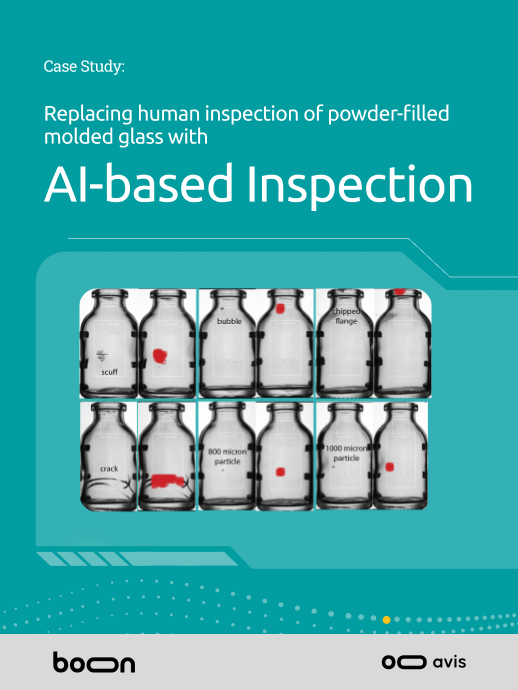
The performance consequences are measurable. AVIS produces documented false reject rates of 1 to 6% on complex products including lyophilized vials, powder-filled containers, and suspensions in molded glass — against the 10 to 30% range that rule-based AVI produces on the same products. A published case study on 20-mL powder-filled molded glass vials documented a 2.7% false reject rate at 98% defect detection accuracy. Recipe creation runs under sixty minutes per SKU on roughly 500 pre-inspected compliant units, against the weeks-to-months of labeled-data curation that supervised AI requires.
On a 5-million-unit, $10/unit line, the difference between a 10% and a 3% false reject rate is approximately $3.5 million per year of recovered yield alone — before any benefit from reduced re-inspection labor, eliminated threshold-tuning labor, fewer inspection-driven deviations, and lower regulatory exposure.
The strategic stakes
Lyophilized injectables are the format the industry is moving toward. Biologics, mRNA vaccines, monoclonal antibodies, orphan drugs, peptide therapeutics, and an expanding share of the cell-and-gene pipeline depend on lyophilization for stability. Sponsor portfolios are weighted toward these formats more heavily every quarter. CDMO capacity has followed.
That trajectory makes lyophilized inspection capability a strategic asset rather than a quality detail. The CMO that runs lyo lines at 10 to 30% false reject rates is operating with a structural margin disadvantage on the highest-value products in the market — and is also accumulating a regulatory exposure profile that surfaces during the next Pre-Approval Inspection on a sponsor’s most important launch. The CMO that has solved lyophilized inspection at a sub-6% false reject rate, with a locked model and full IQ/OQ/PQ documentation aligned to USP <1790> and Annex 1, is operating with a structural advantage on the same products.
The capability gap is observable from the outside. Sponsors writing RFPs for biologic fill-finish work increasingly ask explicit questions about lyophilized inspection methodology — false reject rates, novel-defect detection, audit-trail compliance, recipe creation time. The CMOs answering those questions well are winning the next biologics decade. The CMOs answering them poorly are losing programs they used to compete for.
The decision
Lyophilized injectable inspection breaks the rules that traditional automated vision was built on because the underlying products no longer match the assumptions those rules require. Compliant product is heterogeneous. The defect set is open-ended. Enumeration is the wrong primitive.
The inspection technology that handles lyophilized product correctly inverts the primitive. It learns what compliant looks like and flags everything else. It does not require a labeled defect library. It does not drift between qualifications. It produces documented false reject rates an order of magnitude below the alternatives, and it does so on exactly the formats that the industry is growing into.
That technology exists. The question for any CMO running lyophilized lines today is whether the current inspection program is consistent with the products on the floor next quarter, not the products that were on the floor when the system was first qualified. The two answers produce very different futures.
Read the full disruption thesis. Our white paper on automated visual inspection in pharmaceutical manufacturing walks through the four-modality framework (manual, SAVI, AVI, AVIS), why enumerative inspection fails on complex injectable formats, and the case-study performance of unsupervised AI on lyophilized, powder-filled, and suspension products.