
A Complete Response Letter (CRL) is an FDA communication issued when a New Drug Application (NDA) or Biologics License Application (BLA) cannot be approved in its current form. It is not a rejection. It is a defined list of deficiencies that must be resolved before the FDA will re-examine the application.
CRLs are issued across five deficiency categories: Chemistry, Manufacturing & Controls (CMC); clinical and efficacy data; safety and labeling; facility inspection findings; and administrative issues. In pharmaceutical manufacturing, inspection-related findings — particularly those tied to Automated Visual Inspection (AVI) systems — are among the most time-consuming to resolve, typically adding 6 to 24 months to the approval timeline.
KEY POINT. A CRL does not close the application. Pre-Approval Inspection (PAI) findings that result in an Official Action Indicated (OAI) classification are effectively deterministic for a CRL — and the most common AVI-related triggers are inadequate challenge testing, missing Knapp equivalence data, and 21 CFR Part 11 non-compliance in inspection records.
The Inspection Pathway to a CRL
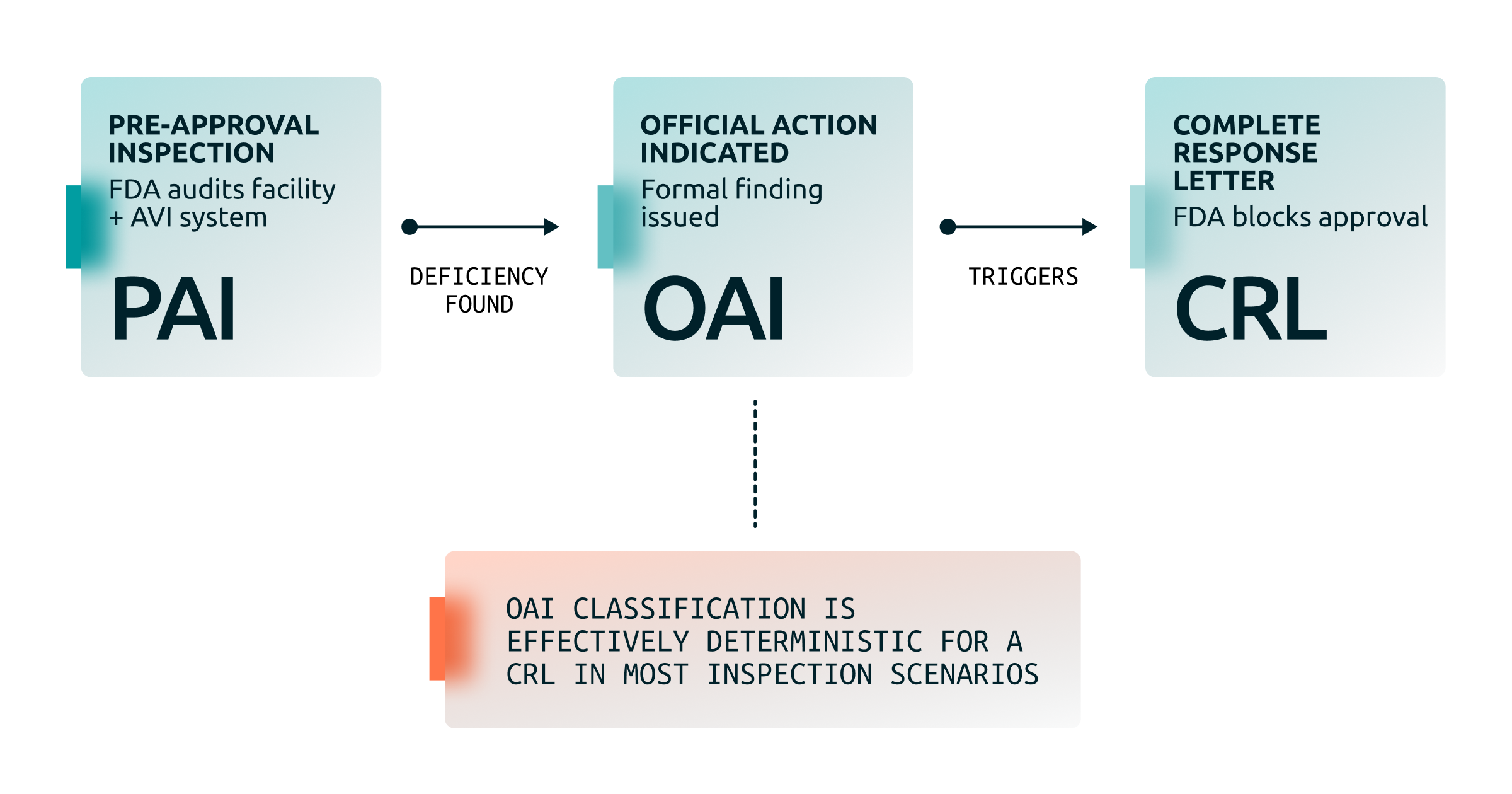
Pre-Approval Inspections follow a defined sequence. AVI systems are evaluated against three criteria: validation and challenge testing across the full defect spectrum; Knapp equivalence studies demonstrating parity with manual inspection; and ongoing performance monitoring with documented investigation triggers.
Systems trained on defect libraries — requiring engineers to enumerate every possible failure mode in advance — create structural inspection risk. When an investigator presents a defect type not in the training set, the system fails to flag it. That failure becomes a 483 observation.
Responding to a CRL
A Complete Response must address every CRL deficiency without exception. For inspection-related findings, remediation typically requires:
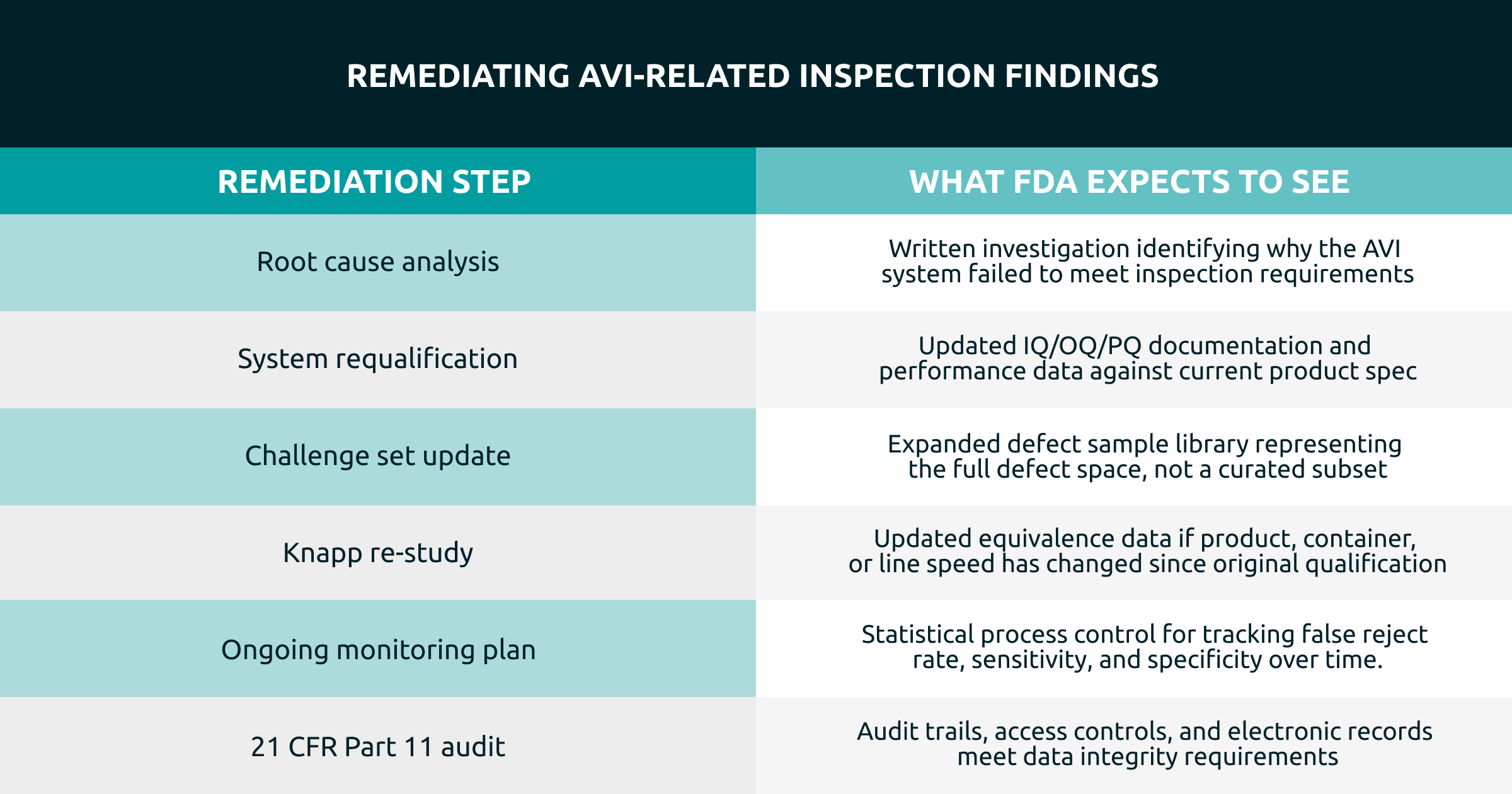
- Written root cause analysis for each AVI system finding
- Updated IQ/OQ/PQ documentation and challenge set expansion
- Knapp re-study if product, container, or line speed has changed
- 21 CFR Part 11 audit trail and electronic record compliance demonstration
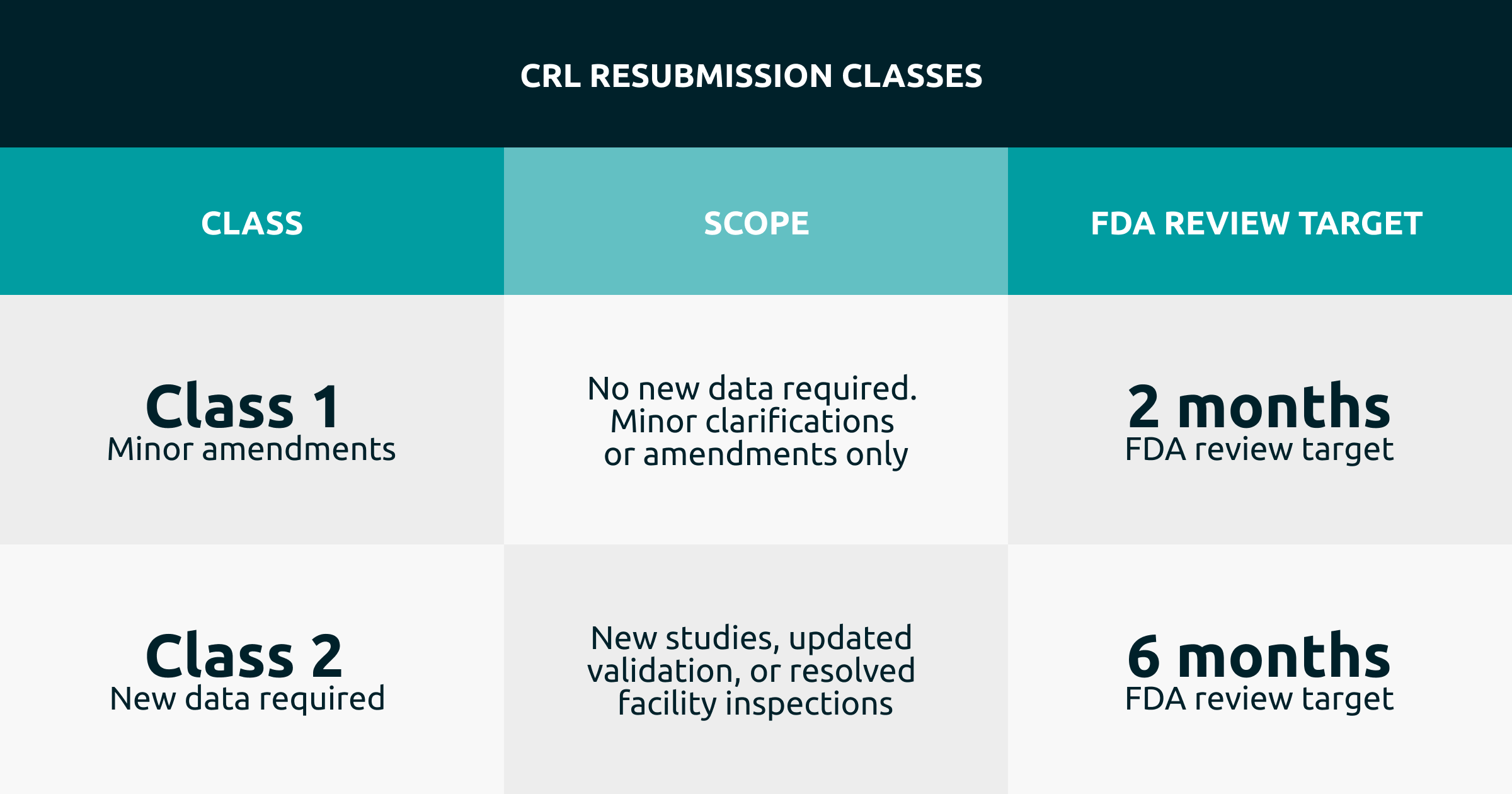
TIMELINE NOTE. Class 2 resubmissions involving facility inspection remediation typically require 6 to 12 months to prepare — longer if AVI revalidation or new Knapp studies are required. Starting remediation before formal CRL receipt (based on 483 observations) compresses this timeline significantly.
Where AVI Systems
Create Inspection Risk

Automated Visual Inspection systems are subject to specific FDA expectations outlined in the USP <1790> chapter, the EU Annex 1 (2022 revision), and FDA guidance on process validation and inspection method qualification. Inspectors evaluate three core areas:
1 — System Qualification and Challenge Testing
The AVI system must demonstrate consistent detection of all defect categories specified in the product specification. This requires validated challenge sets — physical samples or surrogate defects — that represent the full defect space, including visible particulate, container defects, and cosmetic anomalies.
The critical failure point: systems trained exclusively on defect libraries cannot detect novel or edge-case anomalies. When an inspector presents a defect type not represented in the training set, the system fails to flag it. This becomes a direct 483 observation.
2 — Knapp Studies and Detection Equivalence
Before an AVI system can replace manual inspection, the facility must demonstrate that the automated method is equivalent to — or better than — trained human inspection. Knapp studies provide this demonstration by measuring detection rates across human and machine inspection of the same sample set.
A Knapp study is not a one-time event. When product formulations change, container-closure systems change, or line speeds increase, re-qualification is required. Facilities that operate AVI systems without current Knapp equivalence data are exposed on inspection.
3 — Ongoing Performance Monitoring and Retraining Controls
AVI system performance must be monitored in production. False reject rate trends, challenge test results, and any significant changes to the inspection environment must be documented and reviewed. Systems that show degrading performance without documented investigation create data integrity findings.
Responding to a CRL:
What Sponsors Must Do
A Complete Response submission is a formal regulatory filing. It must address every deficiency identified in the CRL — without exception. Partial responses or selective remediation are treated as incomplete and will trigger a second CRL.
The Complete Response Submission Framework
- Acknowledge all deficiencies in writing, with a point-by-point response to each CRL item
- Provide new or supplemental data for any finding that requires technical remediation
- Include updated validation reports, protocols, or manufacturing records where inspection findings were cited
- Demonstrate corrective action for any 483 observations that contributed to the CRL
- Submit as Class 1 (minor amendments) or Class 2 (new data required) based on the scope of remediation
Remediating AVI-Related Inspection Findings
When the CRL cites AVI system deficiencies, the remediation path requires addressing both the technical root cause and the validation record. The following steps represent the minimum expected scope:
How AVIS Addresses Inspection
Risk at the Source
Most AVI systems create inspection risk because of how they are trained. A defect-library approach requires engineers to enumerate every possible failure mode before inspection begins. In practice, this means detection is bounded by what was anticipated — not by what is actually present.
AVIS operates differently. It trains on compliant product — learning the full distribution of what acceptable looks like — and flags anything that deviates from that distribution. No predefined defect categories. No ongoing rule library maintenance. No retraining every time a new product variant is introduced.
Compliance-Relevant Capabilities
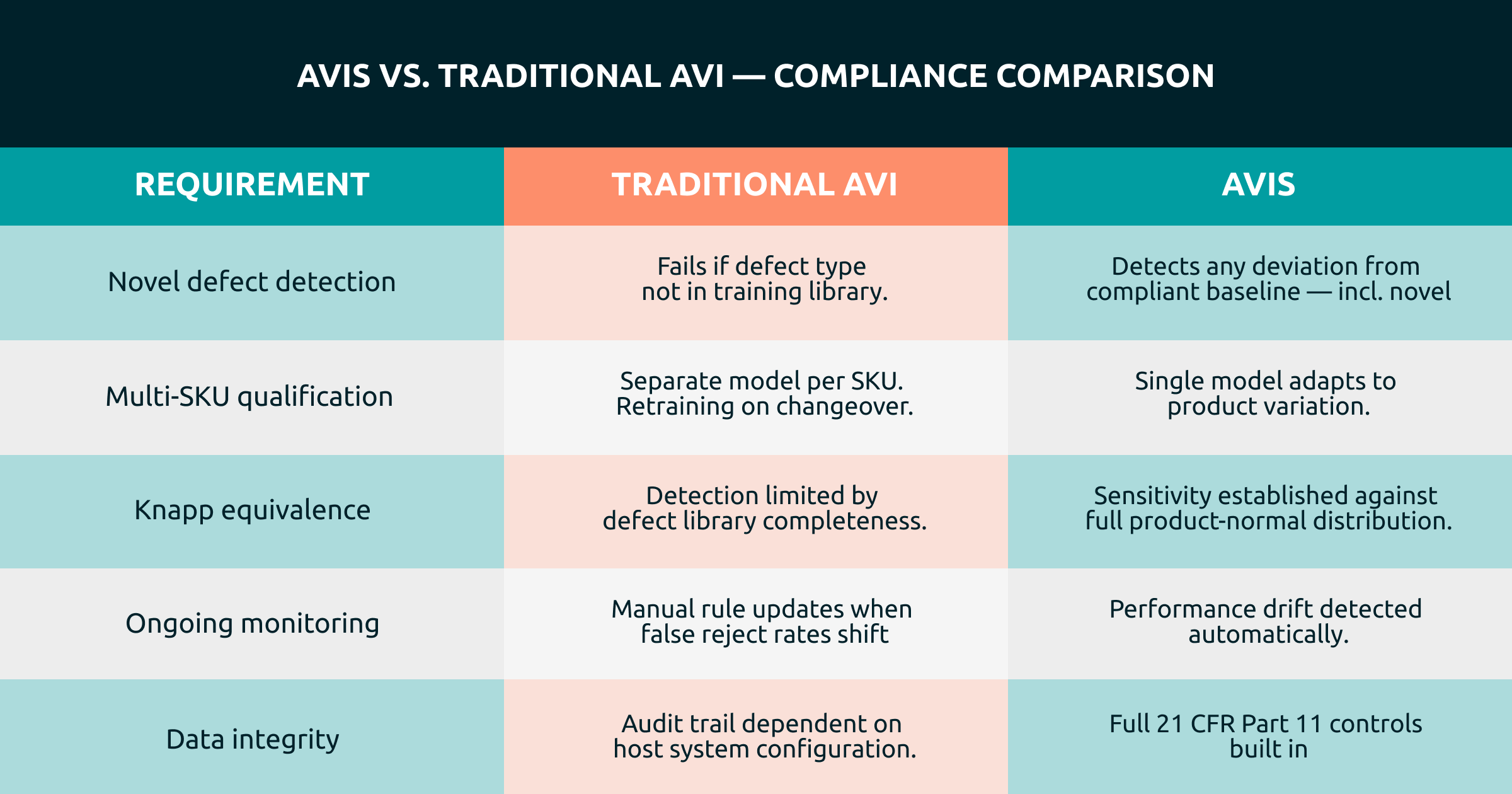
INSPECTION ADVANTAGE. When an FDA investigator presents an out-of-specification container that was not included in the original challenge set, an AVIS-qualified system will still flag it — because AVIS detects deviation from normal, not deviation from a predefined defect category. This is the core argument for unsupervised anomaly detection in a PAI context.
Supporting Validation Documentation
Boon Logic provides qualification documentation support as part of deployment. This includes:
- Validation Master Plan template aligned to FDA process validation guidance (2011) and EU Annex 1 (2022)
- IQ/OQ/PQ protocol templates pre-mapped to AVIS system architecture
- Challenge study design guidance and statistical analysis templates for Knapp equivalence studies
- Ongoing performance monitoring framework with alert thresholds and investigation triggers
- 21 CFR Part 11 compliance matrix documenting audit trail, access control, and electronic record configurations
Reference: Key Regulatory Citations
The following regulatory documents define the FDA’s expectations for automated visual inspection in pharmaceutical manufacturing. These are the primary references inspectors use when evaluating AVI systems during PAIs.
| Document | Relevance to AVI / CRL |
|---|---|
| FDA Guidance: Process Validation: General Principles and Practices (2011) | Establishes three-stage validation lifecycle; applies directly to AVI system qualification |
| USP <1790> Visual Inspection of Injections | Defines inspection method requirements; specifies Knapp study design for AVI equivalence |
| EU GMP Annex 1: Manufacture of Sterile Medicinal Products (2022) | Comprehensive revision includes dedicated AVI section; now referenced by FDA in PAI context |
| 21 CFR Part 11: Electronic Records; Electronic Signatures | Data integrity requirements for AVI inspection records and electronic batch documentation |
| FDA Guidance: Data Integrity and Compliance with Drug CGMP (2018) | Defines ALCOA+ principles; directly applicable to AVI system audit trail requirements |
| ICH Q10: Pharmaceutical Quality System | Provides framework for ongoing monitoring and change control of AVI systems post-approval |
Questions on AVI qualification
or CRL remediation strategy?
Boon Logic works with pharmaceutical manufacturers and CDMOs from initial system qualification through PAI preparation and CRL response support. Our team has direct experience with the validation documentation and challenge study design that FDA investigators examine during pre-approval inspections.
Contact us to discuss your specific inspection timeline or qualification requirements: [email protected]