

Most vendor-written fit guides arrive at the same conclusion: you’re a fit. This one is written a little differently. AVIS solves a specific set of inspection problems very well, and a few others less well, and the quickest route to a useful evaluation is knowing which group your site falls into before anyone books a demo. What follows is the plain version, where AVIS tends to pay off, where the case gets thinner, and what to have in hand when you’re ready to test it against your own product.
What AVIS is built to do
AVIS is Boon Logic’s automated visual inspection system for injectable pharmaceuticals. It runs on Nano, our unsupervised machine learning engine, and ships on the Dabrico DAI-50, a compact three-camera inspection machine with integrated material handling and ejection. The design choice that matters most for fit is how it learns. AVIS trains only on compliant product, roughly 500 units per SKU, and flags anything that deviates from that baseline. It doesn’t need a labeled defect library, and once a recipe is qualified, the model is locked.
That one decision drives almost everything below. It’s why a recipe takes under 60 minutes instead of weeks, why AVIS can catch a defect type it has never been shown, and why it holds up on products whose normal appearance varies too much for fixed rules to handle.
Five signs your site is a strong fit
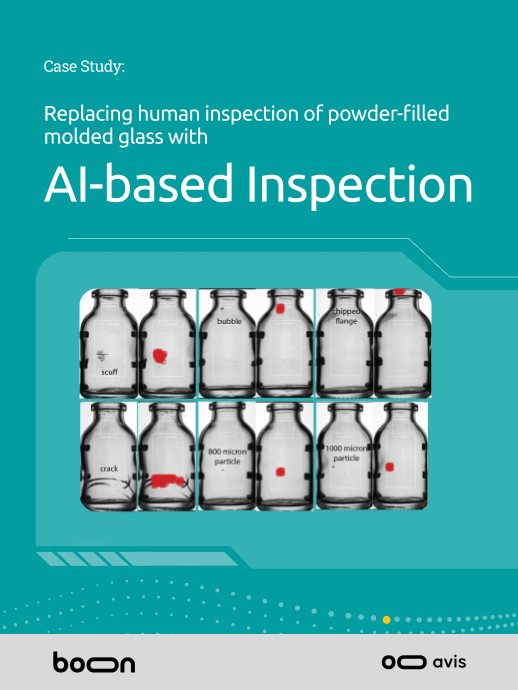
- You inspect products that don’t hold still visually. Lyophilized cakes, powder-filled containers, suspensions, and molded glass all have legitimate variation that rule-based systems often read as defects. That’s where rule-based AVI produces false reject rates in the 10-30% range. AVIS has documented false reject rates of 1 to 6% on those same formats, including 2.7% at 98% detection accuracy on 20 mL powder-filled molded glass vials.
- You run a lot of SKUs at modest volume. Traditional AVI systems typically require about 10 million units per SKU per year to justify the expense of recipe development. However, CDMOs, 503B outsourcing facilities, clinical-supply lines, and orphan-drug programs rarely reach that volume on any single product. AVIS offers sub-60-minute recipe changes, and the DAI-50 can switch between stored recipes in minutes with no model rebuilding or requalification.
- False rejects are already a number being scrutinized. When a rejected product routinely goes back for manual re-inspection, or your finance team can put a figure on the scrap, the business case comes together quickly. For a typical 5-million-unit line at $10 a unit, moving from a 10% to a 3% false reject rate recovers roughly $3.5 million a year in yield alone.
- Manual inspection is carrying more of the load than you’d like. Trained inspectors are capable, but they’re inconsistent across shifts, inspector turnover commonly runs 20 to 40% a year, and inspector variability is a recurring theme in FDA Form 483 observations. In a Knapp study benchmark against manual inspection, AVIS delivered 88% fewer falsely accepted defects.
- Time matters as much as capital. AVIS typically goes from purchase order to qualified production in about six weeks, compared with 12 to 24 months for traditional AVI or supervised AI alternatives. For teams where a capital review would add months, there’s also a subscription path, which usually moves through procurement far faster than a multi-month CapEx cycle.
Where the case gets thinner
Some products and production lines are a poorer fit for AVIS. The clearest example is a single, high-volume, clear liquid product that’s already running well on a tuned rule-based line. Rule-based inspection was built for exactly that kind of product. When the false-reject rate is truly acceptable, and the defect catalog is stable, the gain from switching is smaller. AVIS still brings a locked model and the ability to catch defects nobody cataloged, but the financial argument is far less simply on yield recovery. (If “acceptable” on that line means double digits, that’s a different situation.)
Line speed is the second boundary. The DAI-50 inspects up to 50 units per minute. If your inspection step has to run well beyond that on a single station, the turnkey DAI-50 configuration probably isn’t the answer as it stands, and that’s worth raising in the first call, not the fifth.
Third, AVIS needs compliant product to learn from. Around 500 pre-inspected, compliant units per SKU isn’t much, but for a brand-new product or a very short clinical run, it’s worth planning when those units will actually be available.
And finally, scope. AVIS is built and validated for injectable pharmaceuticals, and that’s where all of its published performance comes from. Nano powers other Boon Logic products outside pharma, but those are different products with different evidence behind them.
What to have ready before an AVIS demo
To ensure the demo provides relevant, specific performance data, it helps to know a few details about your line:
- The container formats and fill types you inspect
- How many SKUs run through the line and at what annual volume
- The line speed you need
- Your current false reject and re-inspection rates (estimates are fine)
- The level of validation support your QA team expects, anywhere from documentation only to full on-site qualification help
These inputs are what determine the scope and price of AVIS, so having them early shortens everything after. If one product causes most of your rejects today, that’s the one to run AVIS against.
The decision
If three or more of the five signs above describe your site, AVIS is very likely worth a serious look, and the evaluation will probably move faster than you expect. If your situation sits mostly in the second list, it may still make sense, but the reasons will be narrower, and we’d rather tell you that on the first call than have you find it out later. Either way, the answer should come from your product and your numbers. Not from a brochure, this one included.
Further reading
What Is AVIS? · Get a Scoped Estimate