AVIS is Boon Logic’s automated visual inspection system for injectable pharmaceuticals.
It uses our unsupervised machine learning technology, Nano, to learn what compliant product looks like and identify anything that falls outside of that normal state.
That difference is important. Traditional automated visual inspection systems rely heavily on rules, thresholds, or libraries of known defects. Supervised AI systems need examples of the defects they are expected to identify.
AVIS takes a different approach.
It learns normal.
Training starts with compliant product
AVIS does not require a defect library.
A new recipe can be trained using approximately 500 compliant units. As those units move through the inspection system, AVIS learns the normal variation within each region of interest captured by the cameras.
Once training is complete, that understanding of normal becomes the baseline for inspection.
When AVIS sees something that falls outside of that baseline, it identifies the unit for rejection.
This means AVIS does not need to see every possible defect during training before it can identify something abnormal in production.
For pharmaceutical manufacturers, that removes one of the biggest challenges associated with traditional AI inspection systems: finding, labeling, maintaining, and continuously expanding large libraries of representative defects.
A recipe can be created in under an hour
Creating a new AVIS recipe starts with approximately 500 compliant units.
The product is run through the system, the appropriate regions of interest are established for each camera, and AVIS learns the normal variation within those regions.
The process can be completed in under 60 minutes.
That makes it practical to introduce new products and formats without the extended development and tuning cycles associated with many traditional AVI systems.
It is particularly valuable for CDMOs and manufacturers running high mix production environments where new SKUs and product transfers are a normal part of the business.
Built for pharmaceutical manufacturing
AVIS was designed to move beyond an AI model running in a lab.
It is delivered as part of a complete inspection system designed for pharmaceutical production and qualification.
AVIS supports GMP manufacturing requirements and 21 CFR Part 11, including the controls and audit trail required for a validated production environment.
Recipes are qualified and locked before being used in production. Changes are controlled and documented.
Nano is also deterministic. When AVIS evaluates the same input under the same qualified conditions, it produces the same result.
For QA and validation teams, that repeatability matters. The system has to do more than identify defects. Its decisions have to be consistent, traceable, and capable of being validated.
How does it perform?
In a Knapp study using amber 6R vials containing clear liquid, AVIS was tested directly against six trained human inspectors.
The study included 50 unique defect vials across 30 trials, covering particulate contamination, container and cosmetic defects, closure and seal defects, and fill level deviations.
AVIS achieved a 98.7% Probability of Detection.
The six trained human inspectors achieved 91.1%.
That is a 7.6 percentage point improvement in defect detection over the human benchmark.
The product was intentionally challenging. Amber glass reduces contrast, changes how light behaves through the container, and makes particles, fill levels, and closure defects more difficult to see consistently.
The human inspection trials were also conducted across multiple days and different times of day to better represent actual production conditions.
For us, that is the important comparison.
AVIS is not being measured against a theoretical inspection standard. It is being measured against trained inspectors looking at the same product and the same defects.
98.7% AVIS Probability of Detection
91.1% Human Probability of Detection
And unlike human inspection, AVIS does not get tired, lose concentration, or change its decision based on the time of day or length of a shift.
Solving inspection problems that are difficult to automate
One of the strengths of AVIS is its ability to learn normal product variation without requiring engineers to define every acceptable variation in advance.
That becomes especially useful with products that are difficult to inspect using fixed rules.
In one application, a pharmaceutical manufacturer had approximately 10 million prefilled syringes quarantined because of a short shot defect that was difficult for human inspectors to consistently identify.
AVIS learned the normal movement of the syringe components during inspection and identified the abnormal condition associated with the defect.
The system achieved 100% detection of the targeted defect during the evaluation, helping the manufacturer establish a path to reinspect the quarantined product and potentially recover more than $3 million in product value.
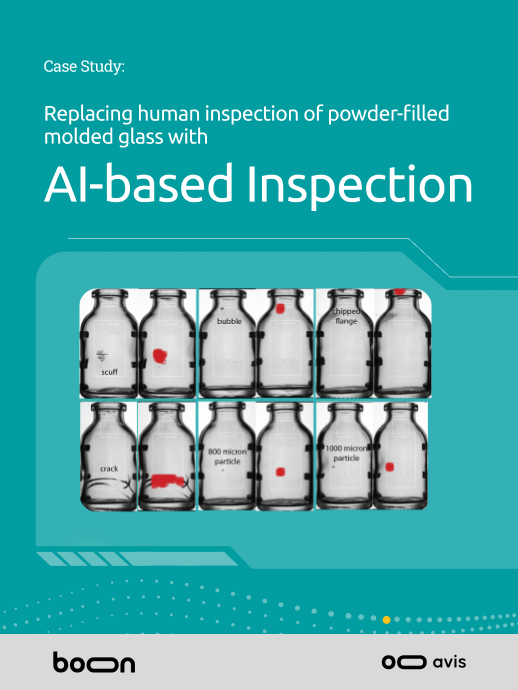
In another application, a CDMO was inspecting 20 mL powder filled molded glass vials.
Both the powder and the molded glass created significant natural variation from unit to unit, making the product difficult to inspect using traditional rules.
AVIS was trained using approximately 500 compliant units. The resulting recipe captured that normal variation while achieving approximately 98% overall defect detection and a false rejection rate of 2.7%.
These are the types of inspection problems AVIS was built to solve.
AVIS is the intelligence. The DAI-50 is the automation.
AVIS does not operate by itself.
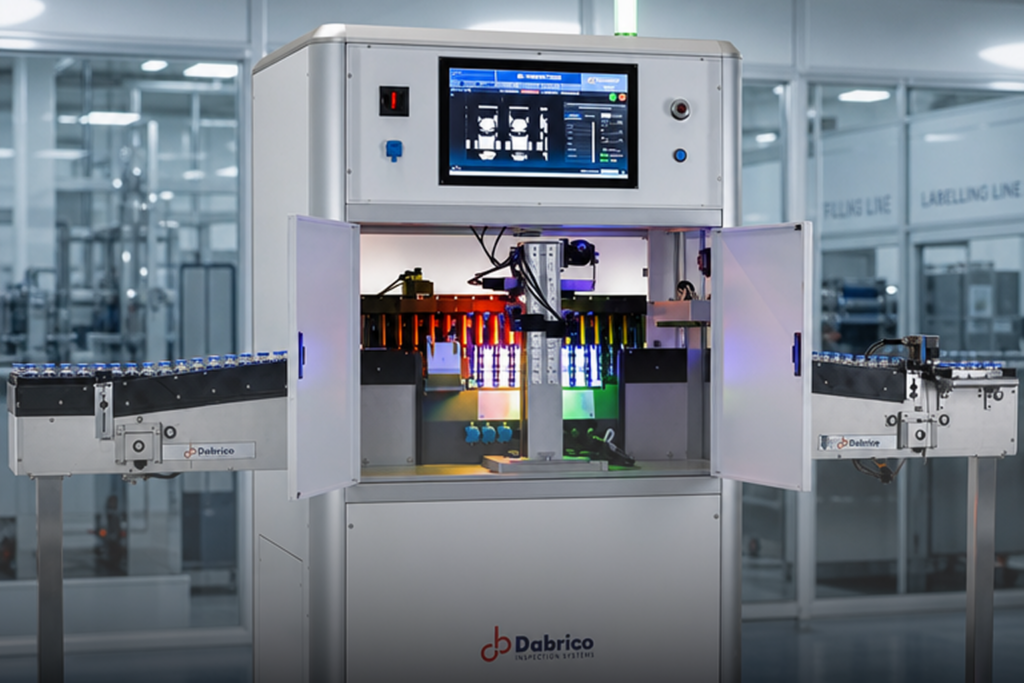
Nano provides the underlying intelligence and AVIS applies it to pharmaceutical visual inspection. That software runs on the Dabrico DAI-50, the production machine that handles the product, captures the images, performs the inspection, and automatically rejects units that fail.
The DAI-50 uses a six-camera inspection array with integrated LED lighting and runs at 75 units per minute. It can handle vials, syringes, and ampoules on the same platform, with container sizes up to 1,000 mL. The system has a footprint of approximately 97 by 74 inches.
Together, AVIS and the DAI-50 provide a complete inspection system.
Customers are not buying an AI model and then being asked to design the cameras, material handling, controls, validation process, and production integration around it.
The system includes the inspection hardware, AVIS software, integrated auto-reject, infeed and exit tables, 21 CFR Part 11 records, and a per-unit audit trail.
It also comes with the support needed to bring the system into production, including FAT, SAT, commissioning support, operator training, and OEM-authored IQ, OQ, and PQ protocols.
That distinction is important. AVIS is not software that still needs to become an inspection system. The DAI-50 gives it the hardware and controls needed to operate on the manufacturing floor.
If you are evaluating the physical system, What Is the DAI-50? goes deeper into supported formats, throughput, changeovers, footprint, and qualification.
Better inspection has a financial impact
False rejects are not just an inspection metric.
Every compliant unit incorrectly rejected by an inspection system represents product that was successfully manufactured and then unnecessarily removed from production.
For high value injectable products, that can become expensive quickly.
Consider a line producing five million units annually at a finished product value of $10 per unit.
At a 10% false rejection rate, $5 million of compliant product is being rejected each year.
Reducing that rate to 3% brings the value of rejected product down to $1.5 million.
That is $3.5 million in compliant product recovered every year.
And that is before considering labor, investigation costs, additional inspection capacity, downtime, or the value of getting new products into production faster.
The CFO’s Guide to Inspection ROI goes deeper into those economics and provides a framework for evaluating the full financial impact of changing inspection technologies.
Where to go next
If you want to understand why pharmaceutical inspection needs a different approach, start with The Gap in Vision Inspection Systems for Pharmaceuticals.
If you are evaluating the equipment itself, What Is the DAI-50? covers the machine in detail.
If you have a product you want to evaluate, the simplest next step is to see AVIS inspect it.
Request a Demo