

A CDMO running twenty or more SKUs doesn’t have one inspection problem. It has twenty, and the list changes every time a new program transfers in. So the useful question isn’t which system posts the best detection numbers on a single product in a demo. It’s which one holds up across the whole portfolio: the lyophilized biologic, the suspension, the powder-filled molded glass, the clinical batch of a few thousand units, and whatever the next sponsor sends over in a couple of months.
Why SKU count is the number that breaks traditional AVI
Rule-based AVI and supervised AI both treat every SKU as its own engineering project. Rule-based systems need thresholds tuned against a defect catalog for each product. Supervised AI needs a labeled defect library for each one, often tens of thousands of annotated images. Either way, building a single recipe typically takes weeks to months. Multiply that by twenty, and the inspection program becomes a permanent engineering backlog, one that grows with every new client.
The economics follow the same curve. Traditional AVI typically needs something like 10 million units a year per SKU to justify recipe development, and most SKUs in a high-mix CDMO portfolio never come close. What usually happens is predictable. The one or two highest-volume products get automated, and everything else stays on manual inspection, which is capable but inconsistent across shifts and inspectors, and harder to staff as the portfolio grows.
There’s a less obvious cost. With rule-based production lines, threshold tuning is where most inspection-driven deviations come from. Increasing the number of SKUs means more tuning, and more tuning means more deviations for the same QA team to investigate.
What regulators expect for every one of those SKUs
The revised EU GMP Annex 1, in force since August 2023, is specific here. Every filled container of a parenteral product must be inspected individually. An automated system must perform as well as manual inspection, be challenged with representative defects before startup and at regular intervals, and its results recorded and trended by defect type. None of that is waived for a low-volume SKU.
France’s ANSM offers a good example. In its review of 30 sterile manufacturing sites inspected between 2023 and May 2025, they recorded 319 Annex 1 non-conformities. Importantly, the automated-inspection findings included systems that didn’t account for critical and major defects, cameras that didn’t cover the entire container, and inadequate challenge testing. For a single-product site, those gaps can be addressed with manual intervention and oversight. But when the production environment spans twenty or more SKUs, each with its own recipe and challenge set, the performance gap becomes unmanageable.
And the inspection program isn’t just a QA matter. A sponsor providing a biologic wants to know how its product will be inspected and how that method will stand up in an audit. That answer is now part of winning the program.
What the right system needs to do for a 20+ SKU portfolio
- Make adding a SKU a routine changeover, not a production engineering project. AVIS builds a recipe in under 60 minutes using roughly 500 compliant units. AVIS trains only on good product and doesn’t need a defect library. Recipe building for an entire twenty-SKU portfolio fits in a few working days rather than a multi-year engineering project, and a new tech transfer doesn’t have to wait in an engineering queue.
- Change over without requalifying. The DAI-50 switches between stored recipes in minutes, with no model rebuilding or requalification. Its compact 36-inch-by-36-inch, three-camera footprint also makes it practical to move between lines, which matters on a floor where the product mix shifts every quarter.
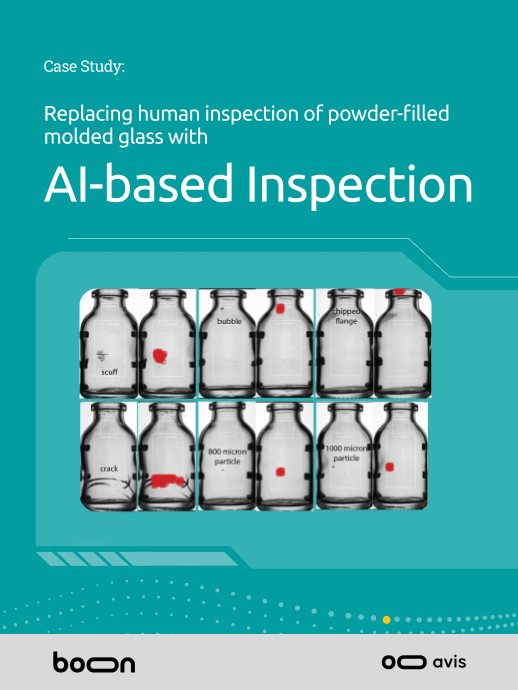
- Handle the formats sponsors actually bring. Lyophilized cakes, powder fills, suspensions, and molded glass are where rule-based AVI produces false reject rates of 10 to 30%. AVIS has documented false reject rates of 1 to 6% on those formats. In one case, a CDMO whose semi-automated equipment missed defects in 20 mL powder-filled molded glass vials used 500 compliant units to build a recipe that reached 98% detection accuracy at a false reject rate of roughly 2.7%.
- Stay locked once it’s qualified. A locked, deterministic model like AVIS produces the same result from the same inspection every time. It also generates a 21 CFR Part 11 audit trail for every inspection event and recipe change. Just as important, routine process variation and product changeovers don’t typically trigger a retrain in AVIS, so twenty qualified recipes will stay twenty qualified recipes.
- Catch defects not anticipated in the library. Because AVIS learns what normal looks like instead of memorizing known defects, it flags a novel defect type the first time it shows up for a CDMO, including a defect specific to a new client’s formulation that nobody on site has seen before.
A straight note on qualification and speed
Two topics are worth clarifying. Annex 1 still expects any automated system to be challenged with representative defects and shown to match or beat manual inspection, so you’ll still need to maintain challenge sets for your products. What AVIS removes is the engineering in between: no defect labeling to train the model and no threshold tuning to keep it running.
The second topic is throughput. The DAI-50 runs at up to 50 units per minute. For the small and mid-sized runs that make up most high-mix portfolios, the system is well suited. However, if one or two of your SKUs are high volume, it’s important to discuss this to ensure those volumes will enable efficient line operation.
The decision
For a high-mix CDMO, the best AVI system is the one whose cost and effort don’t scale with SKU count. Legacy automation was designed for a valuable but narrow production case: one product, very high volume, years between changes. The CDMO that can bring a new SKU into qualified automated inspection in days, keep every recipe locked, and show a sponsor a documented, audit-trailed method is better positioned for the next biologics program. The one still running most of its portfolio on manual inspection, waiting for volumes that won’t arrive, will keep having the same conversation with every new client.
Further reading
What Is AVIS? · What Is the DAI-50?