
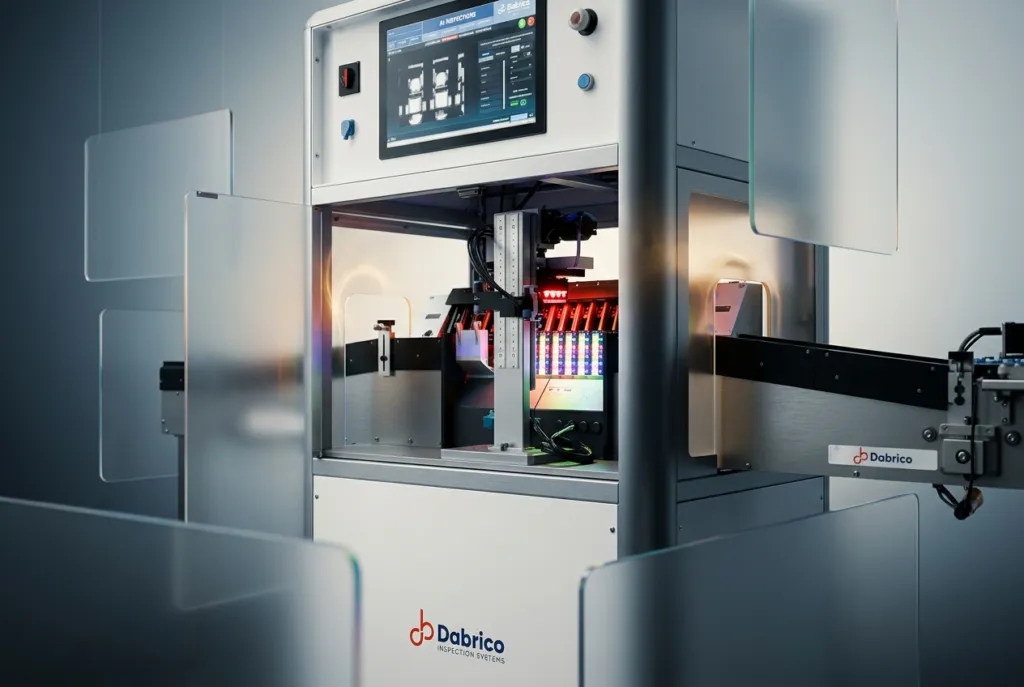
The DAI-50 is the production machine that brings AVIS onto the pharmaceutical manufacturing floor.
It is an automated visual inspection system engineered by Dabrico and powered by Boon Logic’s AVIS technology.
AVIS provides the intelligence. The DAI-50 provides everything needed to physically inspect product at production speed.
Together, they create a complete automated visual inspection system designed specifically for pharmaceutical manufacturing.
AVIS is the intelligence.
The DAI-50 is the machine.
An inspection model cannot inspect a vial on its own.
It needs cameras, lighting, material handling, controls, an ejection system, and a way to move every unit through the inspection process consistently.
That is the job of the DAI-50.
The machine presents each unit to a six-camera inspection array with integrated LED lighting. AVIS analyzes the images and makes the inspection decision. The DAI-50 then handles the physical accept or reject process.
This separation is important.
Boon Logic develops the intelligence behind the inspection. Dabrico engineers the machine that allows that intelligence to operate reliably in a pharmaceutical production environment.
Customers do not have to integrate an AI model into their own inspection equipment or develop the hardware around it.
It arrives as one system.
What does the DAI-50 handle?
The DAI-50 runs at 75 units per minute and uses six cameras to inspect each product.
The platform supports vials, syringes, and ampoules, with container sizes up to 1,000 mL. Its footprint is approximately 97 inches by 74 inches.
The system includes a six-camera inspection array, LED lighting, an 18.5-inch HMI touchscreen, infeed and exit tables, and integrated automatic rejection.
But the hardware is only half of the system. AVIS runs the inspection itself.
Each unit is evaluated against the qualified recipe and the result is recorded through AVIS, including a per-unit audit trail and 21 CFR Part 11 records.
Built for different products
One of the most important advantages of the DAI-50 is that it is not limited to a single product.
The same platform can inspect different container formats and different products using AVIS recipes.
Creating a new AVIS recipe starts with approximately 500 compliant units. AVIS learns the normal variation within the product and builds the baseline it will use during inspection.
That training process can be completed in under an hour.
For manufacturers running multiple products, and particularly CDMOs introducing new products regularly, that changes what is required to bring another product onto the inspection system.
You are not starting another lengthy vision engineering project every time the product changes.
You are creating another qualified recipe on the same platform.
Inspection that stays consistent
Once a recipe has been established, the inspection sensitivity is controlled by that recipe.
The same detection threshold is applied throughout the inspection run, whether the system is inspecting the first unit or the twenty thousandth.
That consistency is one of the fundamental differences between automated and manual inspection.
The machine does not get tired. Its sensitivity does not change between operators or shifts. And the inspection criteria do not depend on someone making the same visual judgment thousands of times in a row.
AVIS and the DAI-50 are designed to make that decision consistently and document the result.
Qualification is part of the system
Getting an inspection machine onto the floor is only part of the job. It also has to be qualified.
The DAI-50 is delivered with Factory Acceptance Testing, Site Acceptance Testing, commissioning support, and operator training.
The validation package includes OEM-authored IQ, OQ, and PQ protocols, along with FAT and SAT protocols and deviation management support.
AVIS also provides the electronic records and audit trail needed to support 21 CFR Part 11 requirements.
This means customers are not buying hardware from one company, AI from another, and then being left to build the validation strategy that connects the two.
The hardware, inspection software, and qualification package are delivered as one solution.
Built by Dabrico.
Powered by AVIS.
Dabrico has more than 40 years of experience building pharmaceutical inspection equipment. That experience matters.
Boon Logic’s expertise is the inspection intelligence. Dabrico’s expertise is building the physical equipment that has to operate every day on a pharmaceutical manufacturing floor.
The DAI-50 brings those two together.
Dabrico handles the cameras, lighting, controls, material handling, and machine engineering. AVIS handles the inspection decision.
The result is a production system built around the technology each company knows best.
Where to go next
If you are evaluating the physical inspection system, the best way to understand the DAI-50 is to see it running.
If you want to understand the technology making the inspection decisions, What Is AVIS? explains how AVIS learns from compliant product and identifies abnormal units without requiring a defect library.
If you want to understand why we believe pharmaceutical inspection needs a different approach in the first place, start with The Gap in Vision Inspection Systems for Pharmaceuticals.
See the DAI-50 in Action