

Traditional automated visual inspection works well on the product it was designed for. A clear liquid in a clear vial, one SKU, very high volume, and years between changes. That describes a lot of commercial manufacturing. It doesn’t describe most CDMOs, where the product mix is wide, the formats keep getting harder, and a new client program can land on the floor with a few months’ notice.
That mismatch is where the case for AVIS starts. Below are the seven reasons that tend to decide it for contract manufacturers, roughly in the order they come up: first engineering, then quality, then business.
1. A new SKU takes under an hour, not months
Rule-based AVI needs thresholds tuned against a defect catalog for every product, and supervised AI needs a labeled defect library for every product. Both typically take weeks to months per product. AVIS is different because it trains only on compliant product, roughly 500 units, and builds a recipe in under 60 minutes. For a CDMO, that can be the difference between visual inspection keeping pace with tech transfers and inspection becoming the bottleneck to throughput and line changes.
2. It holds up on the hard formats
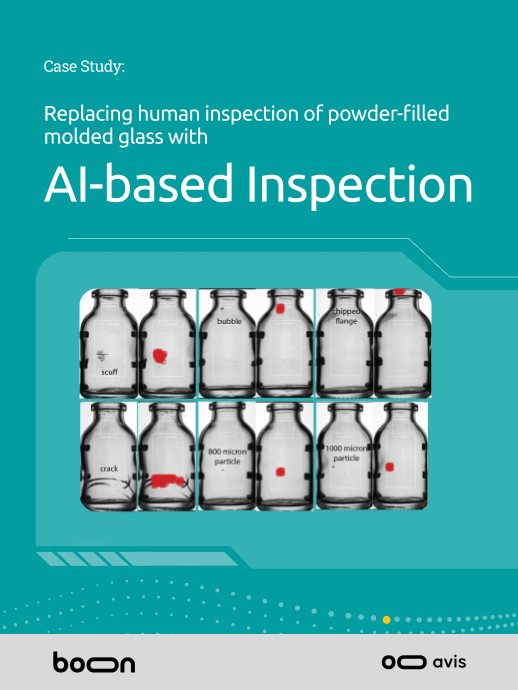
Lyophilized cakes, powder fills, suspensions, and molded glass all carry legitimate visual variations. Yet rule-based systems tend to interpret those variations as defects, resulting in false reject rates ranging from 10 to 30% on those products. AVIS monitors variation from normal instead of relying on predetermined fixed rules, and achieves documented false reject rates of 1 to 6% on the same formats. One CDMO using AVIS, whose semi-automated equipment missed defects in 20 mL powder-filled molded glass vials, built a recipe from 500 compliant units and reached 98% detection accuracy with a false reject rate of roughly 2.7%.
3. It catches defects nobody cataloged
A system trained on known defects can only find known defects. That’s a real limitation for legacy visual inspection systems and for a CDMO, because every new client formulation can bring a failure mode no one on site has seen before. AVIS learns what normal looks like and identifies anything outside normal, so it catches a novel defect type the first time it appears rather than after it has been collected, labeled, and added to a library.
4. The model stays locked
On rule-based lines, threshold tuning drives most inspection-driven deviations, and each new SKU adds more tuning. AVIS is locked after qualification. Its output is deterministic, meaning the same input gives the same result every time, and a 21 CFR Part 11 audit trail records every inspection event and recipe change. Normal process variation and product changeovers don’t typically trigger a retrain. For a QA team already stretched across a large portfolio, that’s fewer investigations and fewer recipes drifting out of their qualified state.
5. It gives sponsors an inspection method they can audit
A sponsor transferring a biologic will want to know the specifics of how a product will be inspected and whether that method will stand up to an inspector. A locked model with full IQ/OQ/PQ documentation and an audit trail is a much easier answer to give than a set of hand-tuned thresholds, or a manual program whose results vary by shift. It also aligns with what EU GMP Annex 1 expects of automated inspection: validated as equal to or better than manual inspection, challenged with representative defects, and trended by defect type. In a Knapp study benchmark against manual inspection, AVIS delivered 88% fewer falsely accepted defects.
6. It’s in production in weeks
AVIS typically takes about six weeks to go from purchase order to qualified production, compared with 12 to 24 months for traditional AVI or supervised AI alternatives. A key difference is the recipe speed. One reason for this difference is that the DAI-50 hardware and the AVIS software are qualified together as one system, so validation isn’t split across two vendors with two packages to reconcile. For a CDMO, a shorter timeline means new capacity can support a client program this year rather than next year.
7. The economics work below blockbuster volume
Traditional AVI typically requires about 10 million units a year per SKU to justify recipe development, which is why most CDMO SKUs stay on manual inspection. AVIS doesn’t carry that per-SKU engineering cost, so the math works at far lower volumes. The CFO’s Guide to Inspection ROI models a representative 5-million-unit, $10-per-unit line, where moving from a 10% to a 3% false reject rate recovers roughly $3.5 million a year in yield alone. And for CDMOs that would rather avoid a capital review, AVIS is also available on a subscription basis, keeping cash free for the next program.
What doesn’t change
Two things are worth saying plainly. Training without a defect library isn’t the same as qualifying without defects. Annex 1 still expects any automated system to be challenged with representative defects, so you’ll keep challenge sets for your products. What goes away is the labeling and tuning in between. And the DAI-50 runs at up to 50 units per minute, which suits the small and mid-sized batches most CDMO portfolios are built on. If a few of your SKUs are high-volume commercial runs, check that figure against their batch sizes early.
The decision
None of the seven reasons is really about a single product. They’re about what happens when inspection has to scale across a portfolio that keeps growing and changing. Traditional AVI charges you again for every SKU, every format change, and every new defect. AVIS doesn’t. For a CDMO trying to win more complex programs without a matching increase in QA and engineering headcount, that’s usually what settles it.
Further reading
What Is AVIS? · What Is the DAI-50?