
Most people find Boon Logic through AVIS. They are looking for a better way to inspect pharmaceutical products, hear about us from a colleague, or see one of our systems running in production.
That usually leads to a simple question.
What exactly does Boon Logic do?
Boon Logic is an AI company built around a core technology called Nano. Nano learns what normal looks like in complex systems and identifies anything that falls outside of it.
It does this without labeled defect data, without a defect library, and without needing thousands of examples of every possible failure.
AVIS, our automated visual inspection system for pharmaceutical manufacturing, is the most advanced commercial application of that technology.
We started with a different approach to AI
Most AI systems learn by being shown examples of what they need to find.
That works well when you have a lot of labeled data. It becomes much harder when the thing you are trying to find is rare, unpredictable, or constantly changing.
Pharmaceutical visual inspection is a good example.
Manufacturers need to identify defects that may occur only occasionally. New products and formats introduce new variables. Some defects may have very few real examples available for training. Building and maintaining a library containing enough examples of every possible defect quickly becomes difficult.
Nano approaches the problem from the other direction. Instead of learning every possible version of abnormal, it learns normal. Give Nano examples of a process operating correctly or products that meet your acceptance criteria, and it builds an understanding of that normal state. When something deviates from what it has learned, Nano identifies it.
That is the foundation behind everything we build.
From Nano to AVIS
AVIS applies Nano to pharmaceutical visual inspection.
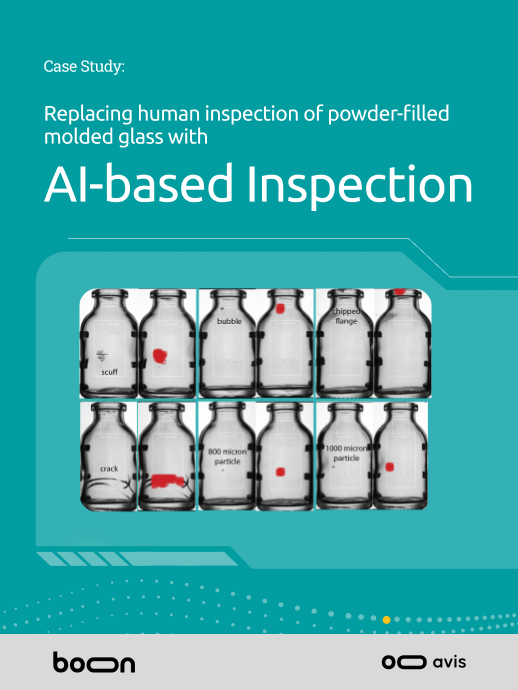
Rather than training AVIS on thousands of images of particles, cracks, cosmetic defects, fill issues, stopper defects, and every other failure mode you might encounter, AVIS is trained using compliant product. Once trained, it inspects every unit against what it has learned.
The result is an inspection approach that does not depend on building and maintaining a defect library. More importantly, we have taken that technology beyond the lab.
AVIS is deployed as a GMP qualified inspection system with the documentation, controls, validation process, and 21 CFR Part 11 capabilities required for pharmaceutical manufacturing.
That distinction matters to us. We are not selling an AI model and asking manufacturers to figure out how to put it into production. We deliver a complete inspection solution designed to operate on the manufacturing floor.
One technology, multiple applications
AVIS is where we have gone deepest, but the underlying technology was not built specifically for pharmaceutical inspection.
The same Nano engine is used across several Boon Logic products. AVIS applies Nano to automated pharmaceutical visual inspection. Amber applies Nano to industrial equipment and process monitoring. Instead of learning what a compliant vial looks like, Amber learns the normal operating behavior of an asset and identifies changes that can indicate developing problems. Nano is also available as the underlying software platform and can run on servers, in the cloud, or at the edge.
PicoAI brings the same approach to resource constrained microcontrollers for embedded applications. The application changes. The principle does not.
Learn normal. Identify what is different.
Why this matters for
pharmaceutical inspection
You do not need to understand Nano to operate AVIS.
But if you are evaluating AVIS as a long term inspection platform, it helps to understand what sits underneath it.
AVIS was not built by taking an existing camera system and adding an AI feature. It is the pharmaceutical application of a technology Boon Logic has spent years developing around one specific problem: identifying abnormal behavior without needing to know every possible abnormal condition in advance.
That approach is particularly well suited to pharmaceutical manufacturing, where products change, defects are rare, and inspection performance has to be repeatable and defensible.
It is also why AVIS looks different from traditional automated visual inspection systems.
Our white paper, The Gap in Vision Inspection Systems for Pharmaceuticals, explains that difference in more detail and looks at why manual inspection, traditional rule based AVI, and supervised AI struggle with many of the inspection challenges manufacturers face today.
If you already understand the problem and want to see how we solve it, What Is AVIS? is the best place to go next.
If you want to understand the machine AVIS runs on, including throughput, formats, changeovers, and qualification, read What Is the DAI-50?
Where to go next
Read The Gap in Vision Inspection Systems for Pharmaceuticals
Understand where traditional pharmaceutical inspection approaches fall short and why a different approach is needed.
See What Is AVIS?
Learn how AVIS trains, inspects product, handles validation, and fits into a GMP manufacturing environment.
See What Is the DAI-50?
Explore the production system that brings AVIS onto the manufacturing floor.