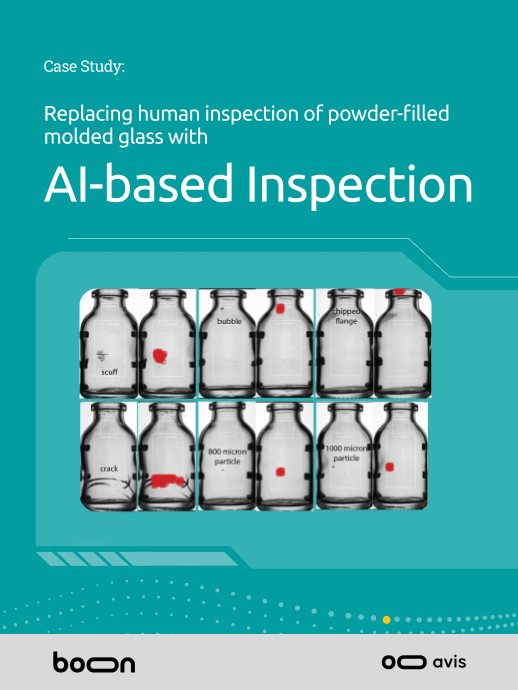

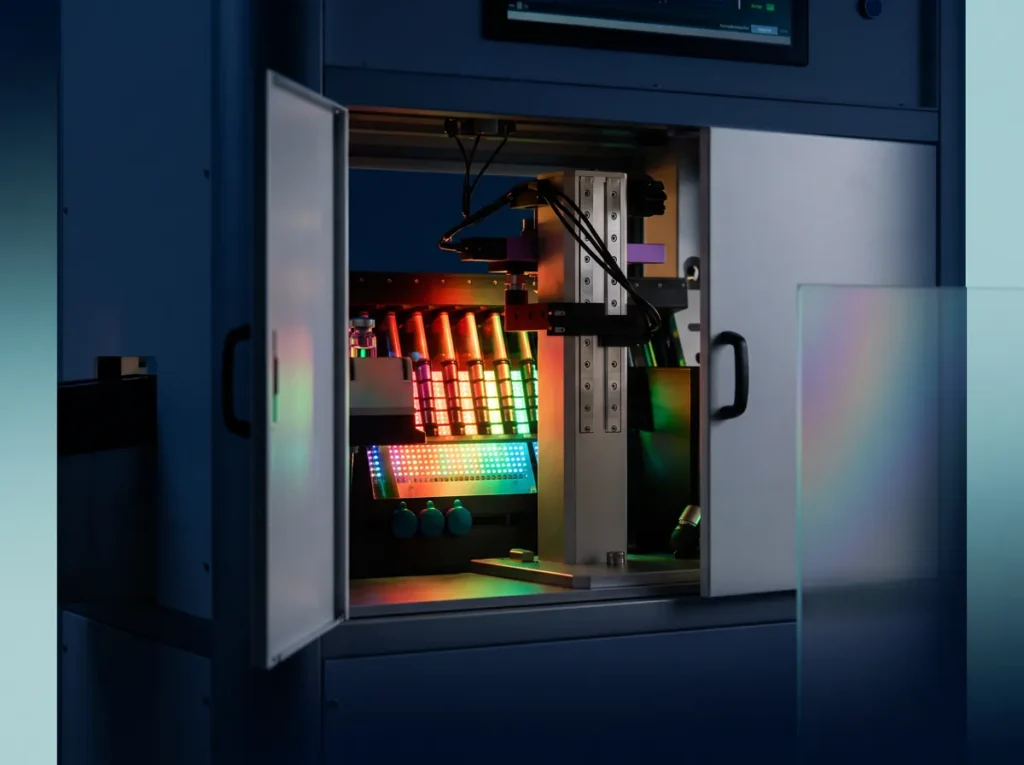
“AI-based visual inspection” is a very broad topic. It can cover everything from a deep-learning model trained on tens of thousands of labeled defect images to an unsupervised system that learns only from “good” product comparisons. It can also mean a model that keeps adapting on the line, or one that’s locked at qualification.
For a CDMO or a 503B outsourcing facility, these differences will determine whether the technology fits a high mix, low-volume operation at all, and how it will hold up in front of an inspector.
This guide makes it easier to identify this distinction and covers how the main inspection approaches differ, and why CDMOs and 503Bs are their own case. It explains what regulators currently expect of AI in GMP inspection, how validation works, and what questions to ask a vendor. This is especially important because the regulatory landscape is changing rapidly.
Start here: find the right guide for your situation
- You’re not sure AI inspection fits your site at all. Start with Is AVIS Right for Your Site? A Best-Fit Brief. It’s an honest two-sided test, including the cases where AVIS isn’t the best first investment.
- You run a CDMO with a wide, changing portfolio. Read Best AVI System for High-Mix CDMOs Running 20+ SKUs for what a system has to do across twenty or more SKUs, then Top 7 Reasons CDMOs Choose AVIS Over Traditional AVI if you’re building the internal case.
- You run a 503B outsourcing facility. Go to Best Automated Visual Inspection System for 503B Outsourcing Facilities. It covers the cGMP expectations, the inspection gaps FDA keeps finding, and what fits a compounding operation.
- You need to know what it costs. See How Much Does an Automated Visual Inspection System Cost? for the factors that set the price of a deployment.
- You’re building the business case for finance. Use The 5-Year Cost of Ownership: Manual vs Traditional AVI vs AVIS for the five-year comparison, and The True Cost of Manual Visual Inspection in Pharmaceutical Manufacturing to put a number on what you’re spending today.
- Your question is mainly regulatory. Read Pharmaceutical Visual Inspection Compliance: FDA Expectations, Documentation and Detection Performance, the companion hub on what inspectors look for and how to show your system performs.
- You’re new to AVIS. Begin with What Is AVIS? and What Is the DAI-50?, then come back here. If none of those is quite your question, the full guide follows.
In this guide
- The four approaches to injectable inspection
- Supervised vs. unsupervised AI, and why the difference matters
- Why CDMOs and 503Bs represent a different inspection challenge
- The regulatory landscape for AI in visual inspection
- How validation works for AI-based inspection
- The performance metrics that matter
- Ten questions to ask any vendor
- Limits and fit
- Frequently asked questions
The four approaches to injectable inspection
Visual inspection of injectables falls into four broad approaches. Two of them use AI, and the difference between them matters far more than the label.
| Approach | How it learns | Recipe time per SKU | False reject rate, complex products | Defect library needed? |
|---|---|---|---|---|
| Manual | Trained inspectors qualified against defect kits | Inspector qualification takes 6 to 12 months | 10 to 20% | Defect kits for training and qualification |
| Rule-based AVI | Engineers tune thresholds against a defect catalog | Weeks to months | 10 to 30% | Yes, per SKU |
| Supervised AI | Model trained on labeled defect images, often tens of thousands per product | Weeks to months | 10 to 20%, degrading on novel defects | Yes, extensive and ongoing |
| Unsupervised AI (AVIS) | Trains only on compliant product and flags any deviation | Under 60 minutes on about 500 compliant units | 1 to 6% documented | No |
Source: Boon Logic, Pharmaceutical Visual Inspection: Four Modalities One-Pager, and The CFO’s Guide to Inspection ROI. Complex products mean lyophilized, powder-filled, suspension, and molded glass formats.
Next step: For what each approach costs over five years, see The 5-Year Cost of Ownership: Manual vs Traditional AVI vs AVIS. For the full case against legacy inspection, read The Gap in Vision Inspection Systems for Pharmaceuticals.
Supervised vs. unsupervised AI, and why the difference matters
A supervised model learns by example. Show it enough labeled images of cracks, particles, and cosmetic flaws, and it gets better and better at recognizing those defects. But the limitation is built in. It can only recognize what it has already seen. For rare or severe failure modes, there often isn’t enough real defect data for the system to identify the defect. And a new formulation can produce a defect nobody has collected yet.
An unsupervised system works the other way around. It learns what normal product looks like, including the legitimate variation in a lyophilized cake or a powder fill, and flags anything that falls outside that envelope. It doesn’t need a defect library to train, and it can catch a defect type the first time that defect appears.
For an operation with a high-variety product mix, the key differences come down to line setup and maintenance time and complexity. Legacy supervised AI requires a curated, labeled library for each SKU and, critically, retraining whenever a new defect type is introduced. Modern, unsupervised AI requires just a few hundred good samples to establish the normal baseline.
Next step: For how AVIS learns from compliant product, and what that means on the line, see What Is AVIS?
Why CDMOs and 503Bs are a different inspection problem
CDMOs
A CDMO’s portfolio is determined by its customers. That usually means a wide range of SKUs, container formats, and a flow of tech transfers, increasingly including lyophilized biologics and other difficult formats. Traditional AVI economics typically require around 10 million units a year per SKU to justify training and recipe development, and most CDMO SKUs struggle to reach these volume levels. The result is not surprising: automation on a handful of high-volume products and manual inspection on everything else.
Next step: CDMO readers, Best AVI System for High-Mix CDMOs Running 20+ SKUs covers portfolio-scale inspection in depth, and Top 7 Reasons CDMOs Choose AVIS Over Traditional AVI lays out the decision in seven points.
503B outsourcing facilities
Section 503B, created by the Drug Quality and Security Act of 2013, lets registered outsourcing facilities compound sterile drugs without a patient-specific prescription, and registration doesn’t waive cGMP. More than 90 facilities are registered, from small producers running under 1,500 units per batch to larger ones running more than 5,000. That’s full cGMP applied to small batches and wide product ranges, the opposite of the profile legacy inspection automation was designed for.
Next step: 503B readers, Best Automated Visual Inspection System for 503B Outsourcing Facilities goes further on registration, Form 483 patterns, and fit.
What both need from an inspection system
- Fast recipe creation per SKU, so a new product or client doesn’t wait in an engineering queue and can go into production quickly.
- Changeover without requalification, since the same station may run many products in a week and changeovers have to happen rapidly.
- Strong performance on difficult formats, not just clear liquid in clear glass.
- A locked, documented model, so a lean QA team can oversee and manage high-quality, high-volume inspection performance.
- Economics that work below blockbuster volume, enabling moderate and smaller volume product lines to run at maximum efficiency and performance.
The regulatory landscape for AI in visual inspection
No regulation prohibits AI-based inspection, and none gives it a pass. The same inspection requirements apply to every method, with a newer layer of AI-specific expectations taking shape on top.
Baseline inspection requirements in the US
FDA’s cGMP regulations require 100% inspection of injectable products. The agency’s December 2021 draft guidance on visible particulates says each final container must be inspected using a qualified method, allows trained personnel, automated technology, or a combination of both, and expects the quality unit to sample each batch for AQL testing afterward. Automated systems are validated using a mix of good and defective units. USP <790> and its companion chapter <1790> set the reference conditions for inspection and describe it as a probabilistic process.
EU GMP Annex 1
Annex 1, in force since August 2023, requires individual inspection of every filled parenteral container. Automated systems must be validated as equal to or better than manual inspection and challenged with representative defects before startup and at regular intervals, and results must be recorded and trended by defect type. It applies to products manufactured for the EU market.
FDA’s draft guidance on AI (January 2025)
In January 2025, the FDA issued draft guidance on using AI to support regulatory decision-making for drugs and biological products. This guidance covers AI models used to produce information about safety, effectiveness, or quality and outlines a seven-step, risk-based framework:
- Define the question the AI model will address.
- Define the model’s context of use.
- Assess model risk.
- Develop a plan to establish the credibility of the model’s output in that context.
- Execute the plan.
- Document the results and any deviations from the plan.
- Determine whether the model is adequate for its context of use.
These guidelines are still in draft form, and it is still unclear exactly how they will apply to manufacturing inspection. Regardless, they are a sound structure for organizing any AI validation package.
EU GMP Annex 22 (draft)
Annex 22, the EU and PIC/S draft annex on artificial intelligence published for consultation in July 2025, is more specific. It covers static models whose parameters are frozen after training, and it requires deterministic output, meaning the same input produces the same result. It excludes continuously learning models, generative AI, and large language models from critical GMP applications. As of August 2026, it was still in draft, with final text expected in the fourth quarter of 2026.
Even before it’s final, the direction is clear. Regulators want AI used in critical GMP applications to be locked and deterministic. Systems designed that way from the start will have an easier time than systems that have to be retrofitted.
Data integrity
21 CFR Part 11 and EU Annex 11 apply to the electronic records and audit trails any automated inspection system produces, AI-based or not.
Next step: For documentation requirements and how detection performance is demonstrated to an inspector, see Pharmaceutical Visual Inspection Compliance: FDA Expectations, Documentation and Detection Performance.
How validation works for AI-based inspection
Validating an AI inspection system looks a lot like validating any automated inspection system. It just adds a few extra questions about the model itself.
- Define the intended use. It’s critical to quantify the products, containers, defect classes, and where the system sits in the inspection sequence.
- Qualify the system. IQ, OQ, and PQ across hardware, software, and line integration. It’s simpler when the machine and model are qualified as one unit, as the Dabrico DAI-50 and AVIS are.
- Rapidly build and lock the recipe. For AVIS, that means the system records roughly 500 compliant units, defines regions of interest for each camera, and builds its baseline in under 60 minutes per SKU.
- Challenge it. Defect challenge sets and comparisons against manual inspection, commonly using the Knapp methodology, show the system performs at least as well as manual inspection.
- Control change. Document when and how the model can be retrained, and treat any retraining as a deliberate, authorized, requalified event.
- Monitor and trend. Record results, trend defect types, and recalibrate at defined intervals.
One point often gets misunderstood: an unsupervised system doesn’t need defects to train, but it still needs defects to qualify. Regulators expect automated systems to be calibrated and challenged with representative defects.
Next step: For why qualifying the machine and the model as one unit shortens the timeline, see What Is the DAI-50?
The performance metrics that matter
Vendor sheets tend to lead with detection accuracy. For a CDMO or 503B, three numbers matter together.
- False reject rate. Compliant product ejected. It drives yield loss, re-inspection, and deviations.
- False accept rate. Defective product passed. It drives patient and regulatory risk.
- Detection accuracy by format and defect class. Headline accuracy on clear liquid says very little about a lyophilized cake.
Ask for results on formats like yours. AVIS’s published results include documented false reject rates of 1 to 6% on complex formats, and 98% detection accuracy at a false reject rate of roughly 2.7% on 20 mL powder-filled molded glass vials at a CDMO. On prefilled syringes, AVIS reached 100% detection of a short-shot defect that human inspectors had been missing, letting the manufacturer re-inspect roughly 10 million quarantined syringes and save more than $3 million in scrap. In a Knapp study benchmark against manual inspection, it delivered 88% fewer falsely accepted defects.
Next step: To see what false rejects and escapes are costing you today, read The True Cost of Manual Visual Inspection in Pharmaceutical Manufacturing.
Ten questions to ask any vendor
- Does the model train on defects, on compliant product, or on both?
- How long does it take, and how many units are required, to build and qualify a recipe for a new SKU?
- Is the inspection model locked after qualification? If not, what triggers retraining, and who approves the change?
- Is the inspected output deterministic?
- What false reject and false accept rates have you documented on formats like ours?
- How does the inspection system handle a defect type it has never seen?
- What does a changeover between stored recipes involve in time and personnel, and does the system require requalification?
- What validation documentation comes with the system, including IQ/OQ/PQ and Part 11 and Annex 11 support?
- Are the hardware and software qualified as one system or separately?
- What throughput does the inspection system support, and should it be a capital expense or an operating expense?
Next step: Pricing questions are answered factor by factor in How Much Does an Automated Visual Inspection System Cost?
Limits and fit
AI-based inspection may not be the right answer for your products and production line, and a good evaluation should identify the limits early.
- Throughput. The DAI-50 inspects up to 50 units per minute. That suits most high-mix batch sizes, but may not fit high-volume commercial SKUs.
- Compliant units. AVIS needs roughly 500 pre-inspected compliant units per SKU to build a recipe, so it’s critical that those units are available on new products and short clinical runs.
- Existing high-performing lines. A single-SKU, clear-liquid line already running well on rule-based AVI has less to gain from switching.
- Scope. AVIS is built and validated for injectable pharmaceuticals, and its published performance comes from that domain.
- Moving regulation. FDA’s AI guidance and Annex 22 are both still drafts. Build validation to current expectations, and monitor guidance for the final documents.
Next step: For a structured way to test these limits against your own site, use Is AVIS Right for Your Site? A Best-Fit Brief.
Frequently asked questions
Does FDA accept AI-based visual inspection?
FDA’s regulations don’t specify a technology. They require 100% inspection using a qualified method and validation of automated systems. AI-based systems are validated within that same framework, and FDA’s January 2025 draft guidance adds a credibility framework for AI models.
What’s the difference between AVI and AVIS?
AVI usually refers to rule-based automated visual inspection, tuned against a defect catalog for each SKU. AVIS is Boon Logic’s AI-based system. It uses unsupervised machine learning and trains only on compliant product.
Does unsupervised AI remove the need for defect kits?
For training, yes. For qualification, no. Challenge testing with representative defects is still expected of any automated system.
How long does deployment take?
AVIS typically goes from purchase order to being qualified and in production in around six weeks. Compare this with legacy inspection systems, traditional AVI or supervised AI alternatives, which take 12 to 24 months.
Can a 503B justify automated inspection?
It depends on SKU count, volume, and financing, but the traditional barrier was per-SKU recipe cost. AVIS recipe costs don’t scale with volume, and a subscription option avoids an upfront capital request. The CFO’s Guide to Inspection ROI identifies subscription as the best fit for CMOs, 503Bs, cell and gene therapy, and clinical-supply lines.
Next step: See How Much Does an Automated Visual Inspection System Cost? and The 5-Year Cost of Ownership: Manual vs Traditional AVI vs AVIS.
Sources
- U.S. Food and Drug Administration. Inspection of Injectable Products for Visible Particulates, draft guidance for industry (December 2021).
- U.S. Food and Drug Administration. Considerations for the Use of Artificial Intelligence to Support Regulatory Decision-Making for Drug and Biological Products, draft guidance (January 2025).
- European Commission. EU GMP Annex 1, Manufacture of Sterile Medicinal Products (2022), sections 8.30 to 8.33.
- European Commission / PIC/S. Draft Annex 22: Artificial Intelligence, consultation (July 2025).
- Pharmaceutical Technology. Europe Tried to Ban Generative AI From Critical GMP (August 2026).
- United States Pharmacopeia. <1790> Visual Inspection of Injections (briefing text).
- ISPE, Pharmaceutical Engineering. Visual Inspection Is Key to Ensuring Patient Safety in US Outsourcing Facilities (July/August 2025).
- Boon Logic. What Is AVIS? (2026); The CFO’s Guide to Inspection ROI (2026); Pharmaceutical Visual Inspection: Four Modalities One-Pager (2026).
Further reading
What Is AVIS? · The Gap in Vision Inspection Systems for Pharmaceuticals